


Table of Contents
Overview
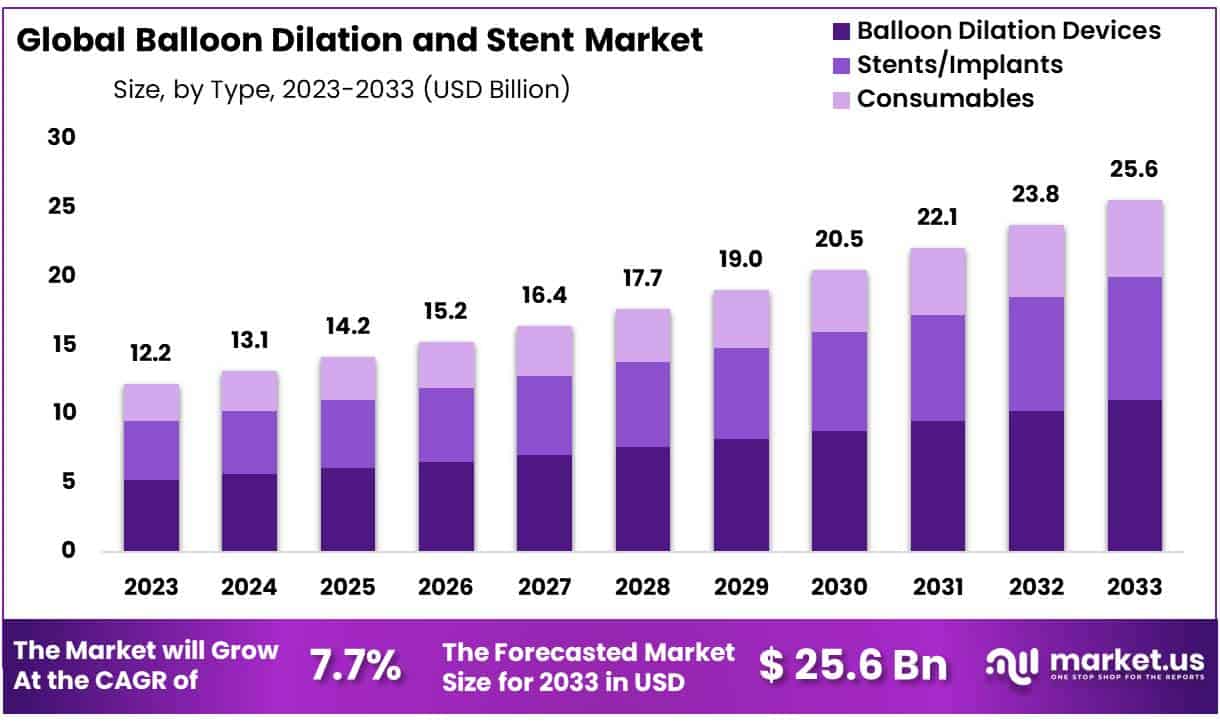
New York, NY – Feb 02, 2026 – The Global Balloon Dilation and Stent Market size is expected to be worth around USD 25.6 Billion by 2033 from USD 12.2 Billion in 2023, growing at a CAGR of 7.7% during the forecast period from 2024 to 2033.
Balloon dilation and stent placement are widely recognized medical procedures used to restore normal blood flow in narrowed or blocked blood vessels. These minimally invasive techniques are commonly applied in the treatment of cardiovascular and peripheral vascular conditions, where vessel narrowing can restrict circulation and increase health risks.
Balloon dilation, also known as balloon angioplasty, involves the insertion of a thin, flexible catheter fitted with a small balloon at its tip. The catheter is carefully guided to the affected area of the vessel. Once positioned, the balloon is gently inflated. This controlled inflation widens the narrowed vessel by compressing plaque against the vessel walls, thereby improving blood flow. After adequate dilation is achieved, the balloon is deflated and removed.
In many cases, a stent is placed following balloon dilation to support long-term vessel patency. A stent is a small, mesh-like tube, typically made from metal or specialized alloys. It is delivered to the treatment site using a catheter and expanded within the vessel. Once deployed, the stent remains permanently in place, acting as a structural scaffold that helps prevent the vessel from narrowing again.
The combined use of balloon dilation and stent placement has significantly improved patient outcomes by reducing symptoms, lowering the risk of complications, and shortening recovery times compared to traditional surgical methods. These procedures are performed under imaging guidance and are associated with high precision and safety standards.
Ongoing advancements in device design and materials continue to enhance the effectiveness and reliability of balloon dilation and stent technologies, supporting their growing adoption across modern clinical practice.
Key Takeaways
- Market Size: The Balloon Dilation and Stent Market is projected to reach approximately USD 25.6 billion by 2033, rising from USD 12.2 billion in 2023.
- Market Growth: Market expansion is anticipated at a compound annual growth rate (CAGR) of 7.7% over the forecast period from 2024 to 2033.
- Product Type Analysis: Balloon dilation devices are expected to remain the leading product segment, contributing nearly 43% of the total market share.
- Indication Analysis: Sinus stenosis is identified as a key growth area, accounting for approximately 32% of the overall market share.
- End-Use Analysis: Hospitals continue to represent the primary end-use segment, holding around 34% of the market share.
- Regional Analysis: North America maintained its leading position in 2023, capturing an estimated 38.4% share of the global balloon dilation and stent market.
Regional Analysis
North America emerged as the leading region in the balloon dilation and stent market in 2023, accounting for a substantial 38.4% share of the global market. This strong regional performance can be attributed to several structural and technological factors that support the widespread adoption of advanced interventional procedures.
The region demonstrates a high capacity for the early adoption and large-scale implementation of innovative medical technologies, including balloon dilation and stent systems. Well-established healthcare infrastructure, favorable reimbursement frameworks, and strong clinical adoption rates have collectively supported market leadership across North America.
In particular, the United States continues to play a central role in driving regional dominance. The presence of globally recognized healthcare research institutions, leading medical device manufacturers, and a robust biotechnology ecosystem has enabled continuous advancements in balloon dilation and stent technologies. These innovations are rapidly translated from research settings into routine clinical practice, reinforcing North America’s competitive position and sustaining its significant share in the global market.
Emerging Trends
- Drug-Coated Balloon Catheters for Coronary In-Stent Restenosis (ISR): In March 2024, approval was granted by the U.S. Food and Drug Administration (FDA) for Boston Scientific’s Agent™ drug-coated balloon catheter, marking the first FDA-approved device specifically indicated for the treatment of coronary in-stent restenosis. The device restores vessel lumen diameter while locally delivering paclitaxel to inhibit neointimal hyperplasia. This approach provides an effective alternative to repeat stenting or intracoronary brachytherapy.
- Origami-Inspired Stents for Neurovascular Aneurysm Repair: Oxford Endovascular has introduced a novel stent design based on origami-inspired folding mechanics, enabling delivery through ultra-low-profile catheters into intracranial vasculature. The company has secured £8 million in funding to support human clinical trials, with first-in-human studies anticipated to begin in 2026 and commercial patient access projected by late 2028.
- Optimized Post-Dilation Strategies in Calcified Coronary Lesions: Recent clinical investigations have enhanced understanding of post-dilation techniques for improving stent expansion in heavily calcified coronary arteries. Evidence indicates that post-dilation using an oversized balloon diameter of +0.5 mm at inflation pressures of approximately 20 atmospheres can achieve optimal target lumen area, thereby improving procedural success and long-term stent performance.
Key Use Cases
Cardiovascular Interventions
Coronary Artery Disease (CAD): Percutaneous transluminal coronary angioplasty (PTCA) remains a cornerstone intervention for CAD, utilizing balloon dilation to restore blood flow in stenotic coronary arteries. The procedure is frequently complemented by stent implantation to maintain vessel patency, resulting in reduced anginal symptoms and improved myocardial perfusion.
Femoropopliteal Arterial Disease: A meta-analysis encompassing 19 studies and involving 923 balloon angioplasties and 473 stent implantations demonstrated comparable long-term outcomes. Three-year primary patency rates reached 61% for balloon dilation in patients with claudication and ranged between 63% and 66% for stent implantation, indicating similar efficacy across treatment modalities.
Neurovascular Applications
Intracranial Aneurysms: A five-year single-center clinical study evaluated 59 patients with wide-neck intracranial aneurysms treated using stent-assisted coiling. Immediate post-procedural angiographic outcomes showed complete occlusion (grade A) in 74.6% of cases. At 12-month follow-up, grade A occlusion rates increased to 78%, confirming durable aneurysm exclusion and procedural effectiveness.
Gastrointestinal Procedure
Esophageal Strictures and Fistulas: Balloon dilation combined with expandable stent placement has demonstrated high technical success in managing esophageal strictures and fistulas. Reported procedural success rates exceed 90%, with symptomatic relief of dysphagia achieved in approximately 90% of treated patients, supporting widespread clinical adoption.
Otolaryngology
Chronic Frontal Sinusitis: A multicenter retrospective analysis assessed balloon catheter dilation (BCD), both with and without steroid-eluting stents, in patients with chronic rhinosinusitis affecting the frontal sinus. Findings confirmed the safety and effectiveness of BCD, while adjunctive stent placement showed favorable safety outcomes without statistically significant incremental clinical benefit.
Respiratory Treatments
Benign Tracheobronchial Stenosis: Clinical evaluation of 59 patients undergoing balloon dilation for benign tracheobronchial stenosis revealed initial symptomatic improvement in 83% of cases. However, symptom recurrence occurred in approximately 80% of patients over a mean follow-up period of 32 months, highlighting a substantial risk of restenosis and the need for adjunctive or repeat interventions.
Frequently Asked Questions on Balloon Dilation and Stent
- In which medical conditions is balloon dilation and stenting commonly used?
The procedure is commonly used in coronary artery disease, peripheral artery disease, biliary strictures, and esophageal narrowing, where vessel or duct expansion is required to improve circulation or passage. - How does a balloon dilation procedure work?
The procedure involves inserting a catheter with a deflated balloon into the narrowed area, inflating it to expand the passage, and often deploying a stent to maintain long-term vessel patency. - What are the advantages of balloon dilation and stents over surgery?
Compared to open surgery, balloon dilation and stenting offers reduced recovery time, lower procedural risk, minimal scarring, and shorter hospital stays, making it a preferred option for many eligible patients. - What risks are associated with balloon dilation and stent placement?
Potential risks include restenosis, blood clots, infection, or vessel damage, although advancements in stent design and imaging technologies have significantly reduced complication rates in recent years. - What factors are driving the growth of the balloon dilation and stent market?
Market growth is driven by rising cardiovascular disease prevalence, increasing geriatric populations, growing demand for minimally invasive procedures, and continuous technological advancements in drug-eluting and bioresorbable stents. - Which regions dominate the balloon dilation and stent market?
North America dominates the market due to advanced healthcare infrastructure and high procedure volumes, while Asia-Pacific is experiencing rapid growth supported by expanding healthcare access and increasing disease awareness. - How is technological innovation impacting the market?
Technological innovation has improved clinical outcomes through advanced materials, enhanced flexibility, and drug-coated balloons, supporting wider adoption and increasing procedural success rates across multiple therapeutic applications.
Conclusion
Balloon dilation and stent placement represent a mature and steadily expanding segment of minimally invasive interventional care. Market growth is being supported by rising cardiovascular and chronic disease prevalence, continuous device innovation, and strong hospital-based adoption. Balloon dilation devices remain the dominant product category, while sinus and cardiovascular indications continue to drive procedural volumes.
North America maintains market leadership due to advanced healthcare infrastructure and rapid technology uptake. Emerging innovations, including drug-coated balloons and next-generation stent designs, are expected to further improve clinical outcomes, reduce restenosis risk, and sustain long-term market expansion across multiple therapeutic applications.
Discuss your needs with our analyst
Please share your requirements with more details so our analyst can check if they can solve your problem(s)




