


Table of Contents
Overview
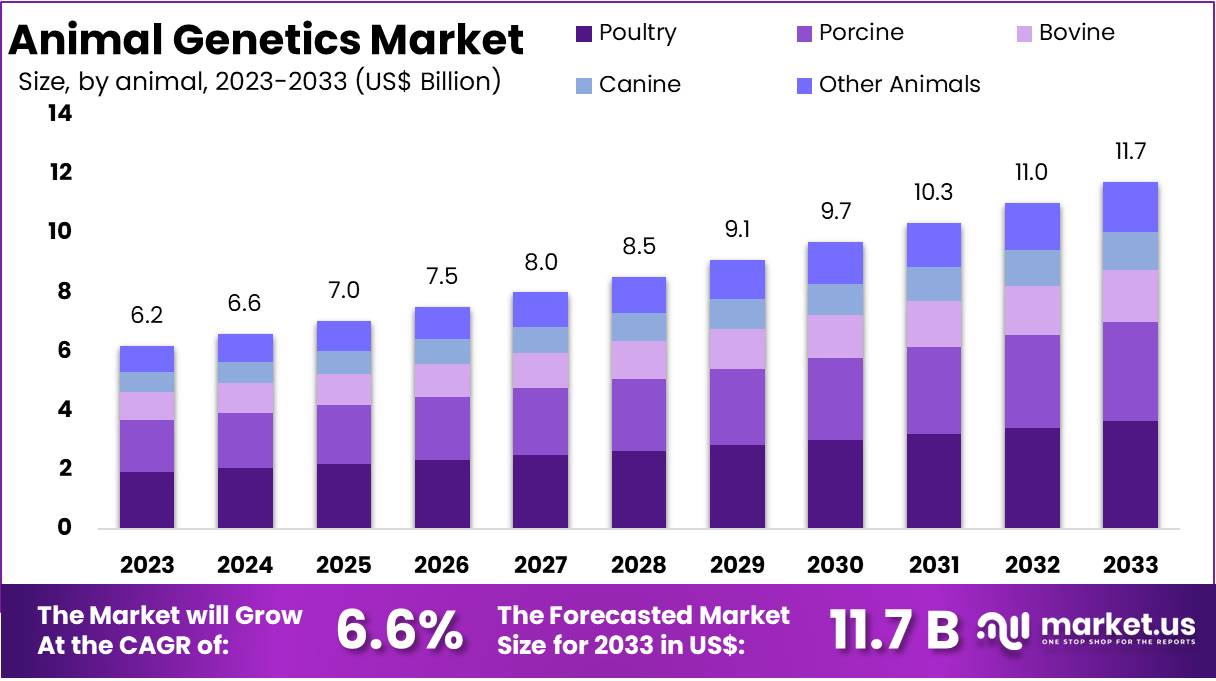
New York, NY – Feb 18, 2026 – The Global Animal Genetics Market Size is expected to be worth around US$ 11.7 Billion by 2033, from US$ 6.2 Billion in 2023, growing at a CAGR of 6.6% during the forecast period from 2024 to 2033.
The establishment of a new entity in the field of animal genetics marks a significant development in modern livestock and companion animal management. Animal genetics focuses on the study of heredity, genetic variation, and trait improvement in animals through scientifically guided breeding practices. This discipline plays a critical role in enhancing productivity, disease resistance, reproductive efficiency, and overall animal health.
The basic formation of animal genetics involves the integration of molecular biology, quantitative genetics, and biotechnology tools. Techniques such as genomic selection, DNA marker analysis, and advanced reproductive technologies are utilized to identify desirable genetic traits. These methods enable precise breeding decisions, reducing production risks and improving long-term herd performance.
In recent years, increasing demand for high-quality protein, sustainable farming practices, and improved animal welfare standards has accelerated investments in genetic research. It is estimated that genetic improvement can enhance livestock productivity by 10–25% over successive generations, depending on species and breeding intensity. Furthermore, disease-resistant lines have been shown to reduce veterinary costs and mortality rates significantly.
The structured implementation of animal genetics programs typically includes data collection, performance recording, genetic evaluation, and continuous monitoring. Collaboration between research institutions, breeders, and industry stakeholders is considered essential to ensure measurable outcomes.
The formation of a focused animal genetics initiative is expected to support sustainable agricultural growth, strengthen food security frameworks, and drive innovation across the global livestock value chain.
Key Takeaways
- The global Animal Genetics Market is anticipated to attain a value of approximately US$ 11.7 billion by 2033, increasing from US$ 6.2 billion in 2023, reflecting a compound annual growth rate (CAGR) of 6.6% during the forecast period.
- Bovine genetics emerged as the dominant animal category in 2023, accounting for more than 31.2% of the overall market share.
- Within the genetic material segment, semen represented the leading type in 2023, securing over 39.6% of the total market revenue.
- Artificial insemination was identified as the leading service segment in 2023, contributing in excess of 32.7% to the global market.
- Genetic trait testing held the largest share within the application segment in 2023, representing more than 28.5% of the total market.
- Animal breeding companies constituted the primary end-user group in 2023, capturing above 40.1% of the market share.
- North America maintained its position as the leading regional market in 2023, reaching a valuation of US$ 1.9 billion and accounting for approximately 31.3% of the global market share.
Regional Analysis
In 2023, North America accounted for over 31.3% of the global animal genetics market, reaching a valuation of US$ 1.9 billion. This leading position has been supported by highly advanced agricultural systems and structured breeding programs across the region. Livestock producers and breeding organizations have widely integrated modern genetic solutions, including DNA sequencing and genomic evaluation, to improve herd performance and enhance overall livestock quality.
A strong penetration of biotechnology tools has further strengthened regional growth. Gene-editing technologies such as CRISPR have been increasingly adopted to improve productivity, enhance disease resistance, and optimize traits related to meat, milk, and egg production.
The region also benefits from a well-established research and development ecosystem. Continuous funding from public institutions and private enterprises has accelerated innovation in genetic testing and reproductive technologies. In addition, the presence of major industry participants and supportive regulatory frameworks promoting ethical standards and animal welfare has reinforced North America’s competitive advantage, positioning it for sustained market leadership in the coming years.
Emerging Trends
- Accelerated Genetic Gain through Genomic Selection: The pace of genetic improvement in dairy cattle has increased significantly following the adoption of genomic selection. Between 2010 and 2022, the average annual gain in net merit rose from approximately USD 40 to USD 85. This improvement reflects enhanced accuracy in breeding value estimation at younger ages, enabling earlier and more reliable selection decisions.
- Rapid Expansion in Genotyping Activity: The global volume of dairy cattle genotyping has expanded at a substantial rate. By August 2022, more than 6.6 million dairy cattle had been genotyped worldwide, with over 1.13 million new genotype records submitted in 2021 alone. This rapid accumulation of genomic data has strengthened the reliability of genetic evaluations and broadened reference populations.
- Increased Reliance on Young Genomic Sires: Breeding strategies have shifted toward greater use of young genomic sires. By 2021, approximately 71% of inseminations in U.S. Dairy Herd Improvement-participating herds were conducted using young genomic sires. This transition highlights strong industry confidence in DNA-based early evaluations for mating and herd improvement decisions.
- Integration of Haplotype Analysis for Recessive Trait Detection: Advanced haplotype-based analytical methods are increasingly utilized to identify harmful recessive genetic variants. In July 2022, nearly 200,000 animals received blended genomic evaluations incorporating tests for 27 recessive conditions, including neuropathy in Jerseys and curly calf syndrome in Ayrshires. These evaluations support proactive management of genetic health risks.
Use Cases
- Improved Selection for Milk Production Efficiency: Genomic testing is being implemented at an early stage, with many producers genotyping heifers shortly after birth. Early genomic evaluations enable identification of high genetic merit animals before first lactation, accelerating the dissemination of superior milk-producing genetics within commercial herds. The availability of over 6.6 million genotypes supports more precise and data-driven selection decisions.
- Data-Driven Herd Management Optimization: Genomic information is increasingly applied beyond sire selection to support broader herd management decisions, including culling and mating design. In 2021, 71% of inseminations were guided by genomic evaluations, facilitating rapid replacement of lower-performing animals and enabling balanced breeding strategies focused on production, health, and genetic diversity.
- Genetic Improvement for Disease Resistance: The identification of recessive disease-associated variants has been incorporated into routine genomic evaluations. Genetic testing for conditions such as early embryonic mortality and skeletal abnormalities allows breeders to reduce trait prevalence over time, improving overall herd health and minimizing associated economic losses.
- Emerging Genomic Applications in Beef Cattle AI Programs: Although artificial insemination adoption remains comparatively lower in beef operations, genomic integration is gradually increasing. In 2020, 19% of U.S. beef heifers were bred via AI, compared with 7% of cows. The incorporation of genotyping into beef breeding programs is expected to enhance genetic selection efficiency, even within extensive production systems.
Frequently Asked Questions on Animal Genetics
- Why is animal genetics important in livestock production?
Animal genetics plays a critical role in enhancing livestock productivity, improving feed efficiency, and strengthening disease resistance. Genetic improvement programs contribute to higher milk yield, better meat quality, and improved reproductive performance, supporting sustainable agricultural development. - What technologies are used in animal genetics?
Advanced technologies such as genomic selection, DNA sequencing, marker-assisted selection, and artificial insemination are widely used. These tools enable accurate trait identification and controlled breeding strategies, thereby accelerating genetic gains in commercial livestock populations. - How does genetic selection improve animal health?
Genetic selection allows the identification and propagation of disease-resistant traits within livestock populations. By reducing susceptibility to infections and hereditary disorders, long-term herd health is strengthened, leading to lower veterinary costs and improved production stability. - Which animal species are commonly involved in genetic improvement programs?
Genetic improvement programs are commonly applied to cattle, poultry, swine, sheep, and aquaculture species. Dairy cattle and broiler chickens represent major segments due to their large-scale commercial production and continuous demand for productivity enhancement. - What factors are driving the growth of the animal genetics market?
Market growth is driven by rising global demand for animal protein, increasing awareness regarding genetic disease management, and the adoption of advanced breeding technologies. Expansion of commercial livestock farming further supports consistent market expansion across emerging economies. - Which regions dominate the animal genetics market?
North America and Europe hold significant market shares due to established livestock industries and technological advancements. However, Asia-Pacific is witnessing rapid growth, supported by expanding dairy and poultry sectors and increasing investments in genetic research infrastructure. - Who are the key participants in the animal genetics market?
The market is characterized by the presence of multinational breeding companies, biotechnology firms, and specialized genetic service providers. Strategic collaborations, mergers, and continuous research investments are commonly observed to strengthen competitive positioning and innovation capacity.
Conclusion
The animal genetics sector is positioned as a critical enabler of sustainable livestock production and long-term food security. Market expansion from US$ 6.2 billion in 2023 to an estimated US$ 11.7 billion by 2033, at a CAGR of 6.6%, reflects strong industry momentum. Growth is being supported by genomic selection, advanced reproductive technologies, and increased genotyping adoption.
Dominance of bovine genetics, semen as a primary genetic material, and artificial insemination services highlights structured breeding integration. Regional leadership by North America further reinforces technological advancement. Continued innovation and data-driven breeding strategies are expected to enhance productivity, disease resistance, and overall herd efficiency globally.
Discuss your needs with our analyst
Please share your requirements with more details so our analyst can check if they can solve your problem(s)




