


Table of Contents
Overview
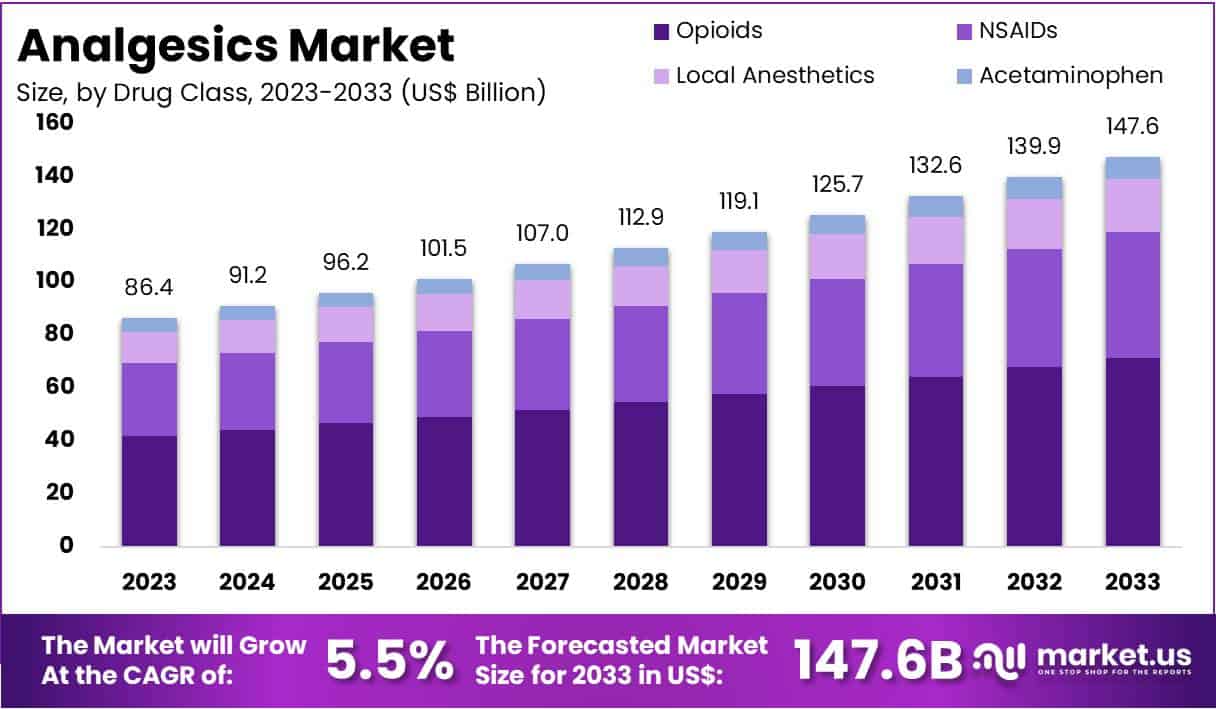
New York, NY – Feb 12, 2026 – The Global Analgesics Market size is expected to be worth around US$ 147.6 Billion by 2033, from US$ 86.4 Billion in 2023, growing at a CAGR of 5.5% during the forecast period from 2024 to 2033. North America accounted for over 41% of the global analgesics market, which was valued at US$ 35.4 billion.
The global analgesics market is characterized by sustained demand driven by the rising prevalence of acute and chronic pain conditions. Analgesics, commonly referred to as pain-relieving agents, are formulated to reduce or eliminate pain without causing loss of consciousness. These products are broadly categorized into non-opioid analgesics, opioid analgesics, and adjuvant analgesics, each designed to address specific levels and types of pain.
Non-opioid analgesics, including nonsteroidal anti-inflammatory drugs (NSAIDs) and acetaminophen-based formulations, are widely utilized for mild to moderate pain management. Opioid analgesics are prescribed for severe pain, particularly in post-surgical and oncology settings. Adjuvant analgesics, such as certain antidepressants and anticonvulsants, are increasingly incorporated into treatment protocols for neuropathic pain.
Market growth is being supported by an aging global population, increasing surgical procedures, and the growing burden of musculoskeletal disorders. In addition, advancements in drug delivery systems, including extended-release formulations and combination therapies, have enhanced therapeutic efficacy and patient compliance.
However, regulatory scrutiny surrounding opioid misuse and addiction has influenced prescribing patterns, leading to increased emphasis on non-opioid alternatives and multimodal pain management strategies. As healthcare systems prioritize effective and safer pain control solutions, continued innovation and strategic product development are expected to shape the competitive landscape of the analgesics market over the forecast period.
Key Takeaways
- The global analgesics market is anticipated to increase from US$ 86.4 billion in 2023 to US$ 147.6 billion by 2033, registering a CAGR of 5.5% during the forecast period.
- Opioid-based products accounted for more than 48.5% of total market revenue in 2023, supported by their extensive use in managing severe and post-operative pain conditions.
- NSAIDs and acetaminophen formulations maintained a substantial share of the market, driven by their cost-effectiveness, broad availability, and established safety profile in treating mild to moderate pain.
- Surgical pain management emerged as the leading application segment, contributing over 48.9% of total revenue in 2023, attributed to the high volume of surgical procedures performed globally.
- Prescription-based analgesics dominated the market with a share exceeding 74.2%, reflecting the strong demand for clinically supervised treatment of moderate to severe pain.
- Oral dosage forms represented more than 46.1% of total consumption, supported by ease of administration and suitability for home-based care.
- Hospital pharmacies accounted for over 40.7% of total distribution, underscoring their critical role in the regulated dispensing of pain management therapies.
- North America held a leading position with more than 41% market share in 2023, supported by advanced healthcare systems, high per capita healthcare expenditure, and established clinical practices.
Regional Analysis
In 2023, North America accounted for over 41% of the global analgesics market, reaching a value of US$ 35.4 billion. This leadership position is supported by advanced healthcare infrastructure, high per capita healthcare expenditure, and strong access to pain management therapies.
A growing geriatric population and the increasing prevalence of chronic pain disorders, including arthritis and lower back pain, have significantly contributed to sustained demand across the region. The United States remains the primary contributor to regional revenue, reinforcing overall market strength.
The availability of both prescription and over-the-counter analgesics has improved treatment accessibility. Hospital systems, retail pharmacies, and established distribution channels further enhance product penetration. Rising awareness regarding effective pain management and early intervention has also supported higher adoption rates.
North America is projected to retain its dominant share over the forecast period. Continued innovation in analgesic formulations, expanding self-care trends, and the persistent burden of chronic pain conditions are expected to drive steady market expansion in the region.
Emerging Trends in the Analgesics Landscape
- Rising Burden of Chronic Pain: Chronic pain prevalence has increased significantly in recent years. In 2023, approximately 24.3% of U.S. adults reported experiencing chronic pain within three months, compared to 20.4% in 2019. This upward trend has intensified demand for effective and sustainable pain management solutions.
- Transition Toward Nonopioid Treatment Approaches: Clinical practice guidelines in the United States increasingly recommend prioritizing nonpharmacologic interventions and nonopioid pharmacologic therapies, including NSAIDs and acetaminophen. These alternatives are preferred due to their comparatively lower risk profiles, supporting a structural shift in prescribing behavior across healthcare systems.
- Reduction in Opioid Prescription Rates: Opioid dispensing rates have declined steadily due to strengthened regulatory oversight and enhanced stewardship programs. Between 2019 and 2023, prescriptions per 100 persons decreased from 46.8 to 37.5, reflecting improved compliance with evidence-based prescribing frameworks and risk mitigation strategies.
- Sustained High Utilization of Analgesics: Analgesics continue to represent the most widely administered therapeutic category in hospital and ambulatory care settings. In 2022, they accounted for 77.4% of hospital drug administrations, totaling 407.5 million events, and comprised the largest share of one billion ambulatory prescriptions.
- Strengthened Emphasis on Abuse Prevention Measures: In 2022, an estimated 8.5 million individuals aged 12 years and older reported misuse of prescription pain relievers. This has accelerated the implementation of prescription monitoring programs, clinician education initiatives, and patient awareness strategies within routine pain management practices.
Key Use Cases of Analgesics
- Management of Acute Postoperative Pain: Opioid analgesics are frequently utilized following surgical procedures to manage acute pain effectively. Their use is generally recommended for short durations, typically three to seven days. In 2023, approximately 125 million opioid prescriptions were dispensed in the United States.
- Treatment of Chronic Non-Cancer Pain: Long-term pain management remains a significant therapeutic challenge. In 2019, about 22.1% of adults reporting chronic pain used prescription opioids within a three-month period. This reliance underscores the ongoing demand for safer and more sustainable treatment alternatives.
- Emergency and Trauma Care Applications: Rapid pain relief is critical in emergency department and trauma settings. In 2022, analgesics were administered or prescribed in 77.4% of emergency department visits, highlighting their essential role in acute injury management and urgent clinical interventions.
- Prevention and Management of Opioid Use Disorder: Approximately 3.7% of U.S. adults, equating to nearly 9.4 million individuals, required treatment for opioid use disorder in 2022. However, only 25.1% received medication-assisted treatment, emphasizing the need for strengthened stewardship and preventive pain management strategies.
- Over-the-Counter Pain Management Applications: Over-the-counter analgesics, including ibuprofen and acetaminophen, are widely used for common conditions such as headaches, musculoskeletal discomfort, and fever. Their broad accessibility and favorable safety profile when used appropriately support extensive self-care practices across diverse population groups.
Frequently Asked Questions on Analgesics
- What are the main types of analgesics?
Analgesics are broadly categorized into non-opioid analgesics, opioid analgesics, and adjuvant analgesics. Non-opioids include acetaminophen and NSAIDs, while opioids are prescribed for severe pain. Adjuvant analgesics are used alongside primary pain therapies to enhance effectiveness. - How do non-opioid analgesics work?
Non-opioid analgesics, such as NSAIDs and acetaminophen, function primarily by inhibiting cyclooxygenase enzymes responsible for prostaglandin production. This mechanism reduces inflammation and pain perception. They are commonly recommended for mild to moderate pain and fever management. - What are opioid analgesics and when are they prescribed?
Opioid analgesics are potent pain-relieving drugs that bind to specific receptors in the brain and spinal cord. They are typically prescribed for severe or post-surgical pain. Due to addiction risks, their use is carefully monitored under medical supervision. - Are analgesics safe for long-term use?
Long-term safety depends on the type of analgesic and dosage. While some non-opioid drugs are considered relatively safe under supervision, prolonged opioid use carries dependency risks. Regular medical evaluation is recommended to minimize adverse outcomes. - Which segment dominates the analgesics market?
Non-opioid analgesics hold a significant market share due to their wide availability and lower risk profile. However, opioid analgesics generate substantial revenue in hospital settings where severe pain management is required. - What are the major regional markets for analgesics?
North America represents a leading regional market due to advanced healthcare infrastructure and high prescription rates. Asia-Pacific is projected to witness faster growth, supported by expanding healthcare access and rising population levels. - How is innovation shaping the analgesics market?
Pharmaceutical companies are investing in the development of abuse-deterrent formulations and non-opioid alternatives. Research efforts are focused on improving efficacy while minimizing side effects, thereby enhancing patient safety and expanding therapeutic applications.
Conclusion
The global analgesics market is positioned for steady expansion, supported by the growing burden of acute and chronic pain, rising surgical volumes, and an aging population. Strong demand across hospital and ambulatory settings continues to sustain revenue growth, while North America maintains market leadership.
Although opioid products retain significant value share, prescribing patterns are increasingly shifting toward non-opioid and multimodal therapies due to regulatory oversight and safety concerns. Innovation in extended-release formulations and abuse-deterrent technologies is strengthening competitive dynamics. Over the forecast period, balanced pain management strategies and product development are expected to drive stable, long-term market progression.
Discuss your needs with our analyst
Please share your requirements with more details so our analyst can check if they can solve your problem(s)




