


Table of Contents
Overview
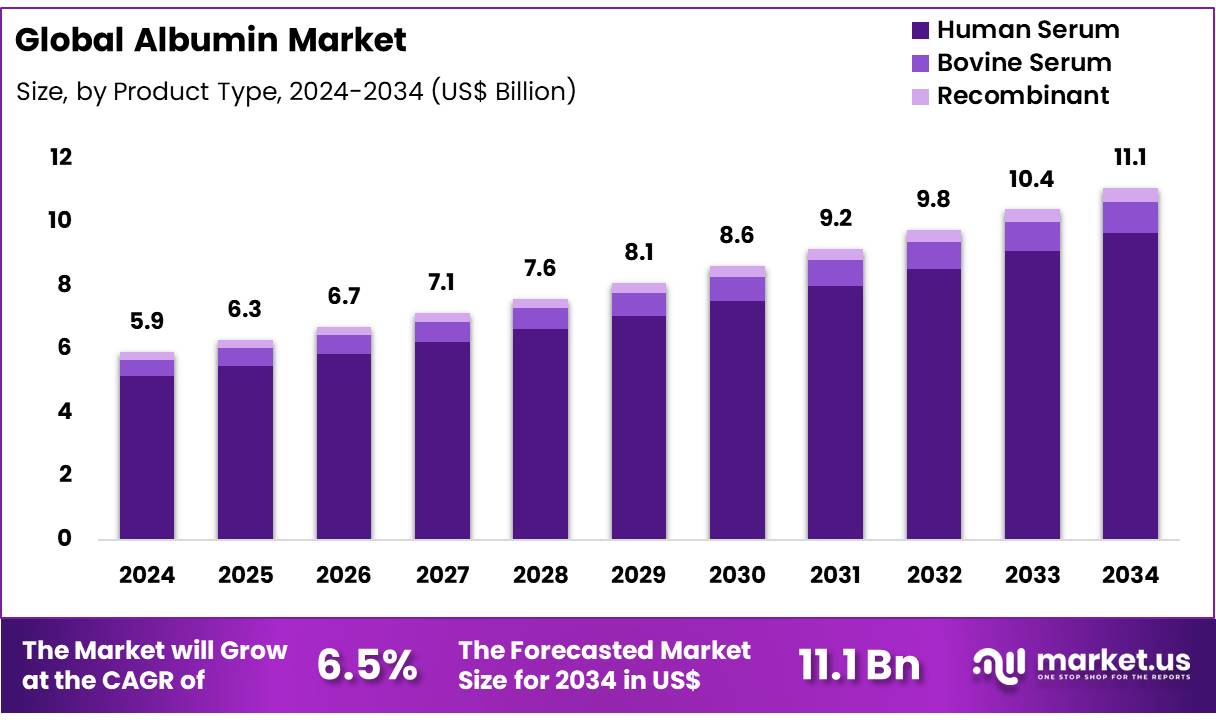
New York, NY – Dec 12, 2025 – The Global Albumin Market size is expected to be worth around US$ 11.1 Billion by 2034, from US$ 5.9 Billion in 2024, growing at a CAGR of 6.5% during the forecast period from 2025 to 2034. In 2024, North America led the market, achieving over 37.5% share with a revenue of US$ 2.2 Billion.
Albumin is a vital protein widely recognized for its essential role in human physiology and its extensive application across healthcare and life science industries. It is the most abundant protein found in human blood plasma, accounting for nearly 60% of total plasma protein content. Albumin is primarily synthesized in the liver through a natural biological process known as protein biosynthesis.
The formation of albumin begins within liver cells, called hepatocytes. Using amino acids derived from dietary proteins, hepatocytes synthesize albumin through ribosomal translation and subsequent molecular folding. Once formed, albumin is released into the bloodstream, where it performs several critical functions. These include maintaining osmotic pressure, transporting hormones, fatty acids, vitamins, and drugs, and supporting overall metabolic balance. The continuous production of albumin is essential, as the body regularly utilizes and breaks down this protein during normal physiological activities.
From an industrial perspective, albumin is commonly derived from human plasma, animal sources such as bovine serum, or produced using advanced recombinant technologies. The extraction and purification processes are carried out under stringent quality and safety standards to ensure high purity, stability, and functionality. These methods are designed to preserve the protein’s natural structure while meeting regulatory requirements.
Albumin continues to be a key component in therapeutic treatments, diagnostic applications, pharmaceutical formulations, and biomedical research. Its stable structure, high binding capacity, and biocompatibility have positioned it as a critical ingredient in modern medical and biotechnology solutions. Ongoing advancements in production technologies are expected to further enhance supply reliability and application scope in the coming years.
Key Takeaways
- The global albumin market was valued at USD 5.9 billion in 2024 and is expected to expand steadily, reaching USD 11.1 billion by 2034, registering a compound annual growth rate (CAGR) of 6.5% during the forecast period.
- In 2024, the human serum albumin segment dominated the global market, accounting for 87.3% of total revenue, driven by its widespread use in therapeutic and clinical applications.
- Based on formulation, the liquid albumin segment emerged as the leading category, capturing 76.4% of the global revenue share, supported by ease of administration and high clinical preference.
- By application, the therapeutics and clinical nutrition segment held a prominent position, contributing 27.4% of the overall market revenue, reflecting increasing utilization in critical care and chronic disease management.
- In terms of end use, diagnostic laboratories represented the largest segment, securing 35.2% of total revenue, supported by rising diagnostic testing volumes and research activities.
- North America retained its leading regional position, accounting for over 37.5% of global market revenue, driven by advanced healthcare infrastructure, high adoption of plasma-derived products, and strong presence of key market participants.
Regional Analysis
North America accounted for the largest share of the global albumin market, supported by a well-developed healthcare infrastructure, a large patient base, and strong investment in research and development activities. The presence of leading hospitals, medical institutions, and research centres has facilitated the extensive use of albumin across a wide range of clinical applications.
In addition, the region is experiencing a significant demographic transition, with a growing ageing population that is more susceptible to conditions such as liver disorders and other chronic diseases requiring albumin-based therapies. According to the American Liver Foundation (2023), over 100 million individuals in the United States are affected by some form of liver disease, with an estimated 80–100 million adults suffering from fatty liver disease, sustaining long-term market demand.
Europe represented the second-largest market share, driven by its established healthcare systems, rising adoption of advanced medical treatments, and strong biopharmaceutical research capabilities. An increasing elderly population and the widespread presence of pharmaceutical and biotechnology companies further support albumin utilization, particularly as a stabilizing agent in drug and vaccine development. Supportive government policies and growing healthcare expenditure continue to reinforce regional growth.
Asia Pacific is expected to register the fastest CAGR, led by rapid healthcare infrastructure development, rising chronic disease prevalence, and expanding biopharmaceutical and biotechnology research. Increasing focus on recombinant albumin production is further accelerating market expansion across the region.
Albumin Key Statistics
- Plasma Concentration: Human serum albumin represents the predominant protein in blood plasma, accounting for nearly 50% of total plasma proteins. Under normal physiological conditions, its concentration in plasma is maintained within the range of 3.5–5.0 g/dL.
- Distribution Within the Body: Approximately 60% of total body albumin is distributed in the interstitial space outside the vascular compartment. The total albumin pool is estimated at 3.5–5.0 g per kilogram of body weight. Of this amount, around 42% is present in the plasma, while the remaining proportion is located in extravascular tissues.
- Physiological Role and Clinical Application: Albumin plays a central role in maintaining plasma oncotic pressure and overall protein balance in the circulation. In clinical practice, it is widely administered to support circulatory function, particularly in patients with advanced liver disease. A 20% albumin solution is generally preferred over a 4% solution due to its lower sodium content.
- Impact of Albumin Infusion: Administration of a 20% albumin solution is associated with a marked expansion of intravascular volume, with blood volume increases of up to four times the infused volume. The reduced sodium load further enhances its suitability for use in critical care settings.
- Metabolism and Turnover: Albumin undergoes continuous turnover, with an estimated daily degradation of approximately 14 g. This represents nearly 5% of total daily whole-body protein turnover in an average 70 kg adult.
- Prevalence and Clinical Implications of Hypoalbuminaemia: Hypoalbuminaemia is observed in roughly 21% of hospitalized adult patients at admission. Reduced serum albumin levels are strongly correlated with poorer clinical outcomes, with survival probabilities declining significantly when concentrations fall below critical thresholds, particularly at 24.5 g/L and 14.5 g/L.
Key Use Cases of Albumin
- Management of Cirrhosis-Related Complications: Albumin is widely administered in patients with liver cirrhosis to reduce the risk of renal dysfunction and hepatorenal syndrome, particularly following spontaneous bacterial peritonitis.
- Blood Volume Expansion: Albumin injections are used for plasma volume expansion in cases of hypovolemia, including shock and severe burns, where rapid restoration of intravascular volume is required.
- Supportive Therapy in Sepsis and Septic Shock: In severe sepsis and septic shock, albumin is utilized to improve hemodynamic stability and support organ perfusion, contributing to overall clinical recovery.
- Applications in Surgical Procedures: During major surgical interventions, especially cardiopulmonary bypass procedures, albumin is used as a priming solution for heart–lung machines to maintain adequate blood volume and circulatory pressure.
- Treatment of Hypoalbuminemia: Albumin therapy is indicated in patients with low serum albumin levels resulting from malnutrition, trauma, major surgery, or infections, helping to restore oncotic pressure and protein balance.
- Neonatal Care: In neonatal medicine, albumin is used in the management of hemolytic disease of the newborn to control bilirubin levels and reduce the risk of severe complications.
- Kidney Disease Monitoring and Management: Albumin plays a key role in assessing renal function through the urine albumin-to-creatinine ratio (uACR), which is used to detect, monitor, and evaluate the progression of kidney disease.
- Nutritional Status Assessment: Serum albumin measurements are commonly used in clinical settings to assess nutritional status and support diagnosis and treatment planning in hospitalized patients.
- Diagnosis of Liver and Kidney Disorders: Serum albumin testing is an essential diagnostic tool for identifying and monitoring liver and kidney diseases, with abnormal levels indicating impaired organ function.
- Fluid Management in Acute Respiratory Distress Syndrome (ARDS): In patients with ARDS, albumin is used to support fluid management strategies, helping to optimize fluid balance and improve pulmonary function.
Frequently Asked Questions on Albumin
- What is albumin and why is it important?
Albumin is a major plasma protein synthesized in the liver. It helps maintain oncotic pressure, transports hormones, fatty acids, and drugs, and supports fluid balance, making it essential for normal physiological and clinical functions. - How is albumin used in medical treatment?
Albumin is widely used in clinical settings for volume replacement, shock management, liver disease, burns, and hypoalbuminemia. Its ability to stabilize blood volume makes it valuable in critical care and emergency medicine. - What are the main sources of albumin?
Albumin is primarily derived from human plasma through fractionation processes. Strict donor screening and purification standards are applied to ensure safety, purity, and consistency, especially for therapeutic and pharmaceutical-grade albumin products. - Are there risks associated with albumin therapy?
Albumin therapy is generally considered safe when properly administered. However, potential risks include allergic reactions, fluid overload, or infection transmission, which are minimized through stringent manufacturing controls and appropriate clinical supervision. - Which sectors contribute most to albumin demand?
Hospitals and clinics account for a significant share of albumin demand due to therapeutic use. Additionally, pharmaceutical, biotechnology, and vaccine manufacturing sectors increasingly utilize albumin as a stabilizer and formulation ingredient. - How does plasma availability affect the albumin market?
Plasma availability directly influences albumin production capacity. Limited plasma collection, regulatory constraints, and dependence on donor supply can impact pricing and supply stability, making plasma sourcing a critical factor in market dynamics. - What is the outlook for the global albumin market?
The global albumin market is expected to show steady growth, supported by advances in plasma fractionation, expanding therapeutic indications, and rising healthcare expenditure, particularly in emerging economies with improving medical infrastructure.
Conclusion
Albumin remains an indispensable protein in both human physiology and modern healthcare, supported by its critical biological functions and broad clinical utility. Its dominant role in maintaining oncotic pressure, transporting key biomolecules, and supporting metabolic stability underpins strong and sustained medical demand.
From a market perspective, steady growth is being driven by rising chronic disease prevalence, expanding diagnostic and therapeutic applications, and advancements in plasma fractionation and recombinant technologies. Regional leadership by North America and rapid expansion in Asia Pacific further reinforce positive market fundamentals, positioning albumin as a strategically important component of global healthcare and life science industries.
Discuss your needs with our analyst
Please share your requirements with more details so our analyst can check if they can solve your problem(s)




