


Table of Contents
Overview
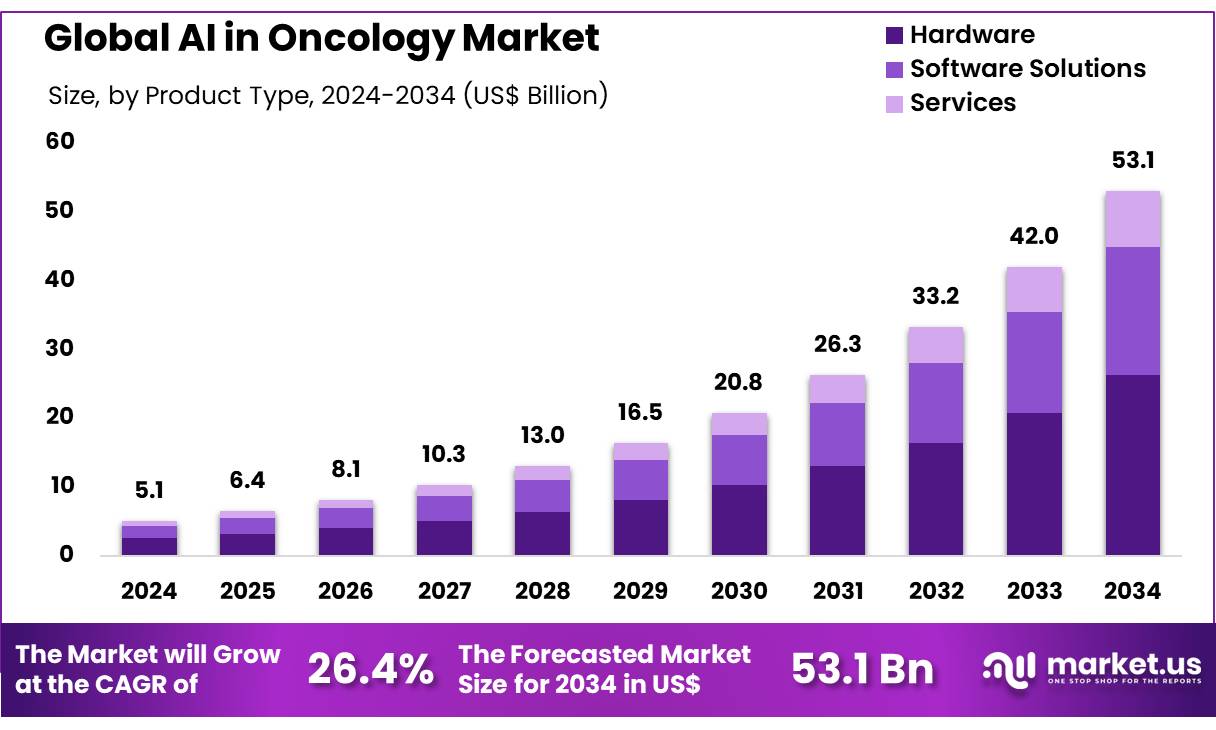
New York, NY – Dec 16, 2025 – Global AI in Oncology Market size is expected to be worth around US$ 53.1 Billion by 2034 from US$ 5.1 Billion in 2024, growing at a CAGR of 26.4% during the forecast period 2025 to 2034. In 2024, North America led the market, achieving over 42.1% share with a revenue of US$ 2.1 Billion.
Artificial Intelligence (AI) is increasingly being integrated into oncology, marking a significant advancement in cancer diagnosis, treatment planning, and patient management. The adoption of AI technologies in oncology is being driven by the growing complexity of cancer data and the need for more accurate, timely, and personalized clinical decisions.
AI-based tools are being widely used to analyze medical images, pathology slides, and genomic data with high precision. These systems are capable of identifying patterns that may be difficult to detect through conventional methods, thereby supporting early cancer detection and improving diagnostic accuracy. As a result, clinical workflows are being optimized, and decision-making processes are being strengthened.
In treatment planning, AI algorithms are being applied to evaluate patient-specific data, enabling more tailored therapy selection. Predictive analytics is being utilized to assess treatment response, disease progression, and potential side effects, contributing to improved patient outcomes and reduced healthcare costs. AI-driven clinical decision support systems are also assisting oncologists in selecting evidence-based treatment protocols.
Furthermore, AI is playing an important role in oncology research and drug development. Large-scale datasets are being processed efficiently to accelerate biomarker discovery and clinical trial design. This is supporting faster innovation and improved success rates in cancer therapeutics.
Overall, the integration of AI in oncology is expected to enhance precision medicine, improve operational efficiency, and support better patient-centered care. Continued investment and collaboration across healthcare stakeholders are anticipated to further expand the impact of AI-driven oncology solutions.
Key Takeaways
- In 2024, the AI in oncology market generated revenue of US$ 5.1 billion and is projected to expand at a CAGR of 26.4%, reaching US$ 53.1 billion by 2034.
- By product type, the market is categorized into software solutions, services, and hardware, with the hardware segment leading in 2024, accounting for a 49.4% market share.
- Based on application, the market is segmented into diagnostics, research and development, radiation therapy, immunotherapy, and chemotherapy. Among these, diagnostics emerged as the leading segment, capturing 47.6% of the total market share.
- In terms of cancer type, the market includes breast cancer, prostate cancer, lung cancer, colorectal cancer, brain tumors, and others. The breast cancer segment dominated the market, holding the largest revenue share of 32.4%.
- By end user, the market is divided into hospitals, surgical centers and medical institutes, and others, with hospitals leading the segment at a revenue share of 50.8%.
- Regionally, North America dominated the AI in oncology market in 2024, securing a market share of 42.1%.
Artificial Intelligence in Oncology Statistics
- Artificial intelligence systems have demonstrated approximately 92% accuracy in detecting cancer from digital pathology slides.
- AI-driven diagnostic models have been shown to outperform conventional state-of-the-art cancer diagnostic methods by up to 36%.
- The AI-based platform CHIEF achieved nearly 94% accuracy in identifying multiple cancer types across varied datasets.
- In focused clinical evaluations, CHIEF reported up to 96% diagnostic accuracy for biopsy-based detection of cancers such as esophageal and gastric cancer.
- Extensive AI research activity in oncology has supported the deployment of AI-enabled tools in more than 50 major cancer centers worldwide.
- The integration of AI in diagnostic imaging workflows has resulted in an estimated 30% improvement in tumor detection rates.
- AI adoption in oncology clinical research is accelerating, with over 30 new AI-driven oncology clinical trials initiated globally in the previous year.
- Investment in AI-focused oncology solutions has grown by more than 200% over the past three years, reflecting strong investor confidence.
- AI-powered patient monitoring systems have been implemented by over 200 healthcare institutions globally, supporting real-time clinical decision-making.
- The number of hospitals utilizing AI for diagnostic purposes has increased by approximately 40% in the last two years.
- Predictive AI models for treatment response assessment and patient prognosis are increasingly integrated into routine cancer care.
- The development of AI models that simulate cancer cell behavior and disease progression increased by nearly 70% year-over-year.
- AI technologies are incorporated into over 60% of newly approved cancer diagnostic devices by regulatory authorities.
- Large-scale oncology datasets, including those from The Cancer Genome Atlas (TCGA), are widely leveraged to develop and validate predictive AI models.
- AI has substantially accelerated the bench-to-bedside transition in oncology by enabling rapid, integrated analysis of genomic, imaging, and clinical data.
Regional Analysis
North America accounted for the largest revenue share of 42.1%, driven by the strong adoption of precision medicine, a rising cancer burden, and continuous advancements in artificial intelligence and machine learning technologies. Healthcare providers across the region are increasingly implementing AI-enabled solutions to improve diagnostic accuracy, optimize treatment planning, and accelerate drug discovery in oncology.
These technologies support the analysis of complex medical imaging, genomic data, and electronic health records, enabling more personalized and efficient cancer care. The growing disease burden further reinforces this trend, as the American Cancer Society estimated 1,958,310 new cancer cases and 609,820 cancer-related deaths in the United States in 2023.
In parallel, the US Food and Drug Administration has actively reviewed and approved AI-based medical devices, including oncology-focused applications, strengthening market confidence. Leading healthcare technology companies continue to invest in AI capabilities, with GE HealthCare reporting revenues of US$19.7 billion in 2024, supported by AI-integrated diagnostic and visualization solutions, while Siemens Healthineers maintains a strong focus on AI-driven cancer technologies.
Asia Pacific is projected to register the fastest CAGR during the forecast period, supported by a large and aging population, increasing cancer incidence, and rising healthcare expenditure. Countries such as China and India reported 4.82 million and 1.41 million new cancer cases, respectively, highlighting substantial unmet clinical needs. Government initiatives promoting digital health adoption, combined with US$2 billion in regional digital health funding in 2024, are accelerating the deployment of AI-powered oncology solutions across the region.
Use Cases
- Precision Medicine: AI is increasingly applied to develop personalized treatment strategies by analyzing genomic variations and predicting individual patient responses to specific therapies, thereby improving treatment efficacy and outcomes.
- Diagnostics and Pathology: Advanced AI models, including solutions such as CHIEF, are utilized for automated cancer detection from digital pathology slides, enabling faster diagnostic workflows while significantly improving diagnostic accuracy and consistency.
- Drug Repurposing: AI-based platforms, such as TxGNN, are leveraged to identify novel therapeutic applications for existing drugs. This approach accelerates drug development timelines and expands treatment options, particularly for rare and underserved disease indications.
- Non-Invasive Biopsies: AI supports the advancement of liquid and synthetic biopsy technologies, allowing cancer detection and disease monitoring through non-invasive methods that reduce patient discomfort and procedural risks compared to conventional biopsies.
- Clinical Decision Support: AI-driven decision support systems integrate with electronic health records to deliver data-driven insights to oncologists, supporting evidence-based treatment selection and optimizing clinical outcomes.
- Radiology and Imaging: AI algorithms enhance the interpretation of medical imaging modalities, including MRI and CT scans, by improving tumor detection, segmentation, and characterization with greater precision.
- Operational Efficiency: AI is applied to optimize clinical operations by automating repetitive administrative tasks, such as documentation and data entry, thereby reducing clinician workload and enabling greater focus on direct patient care.
- Clinical Trials: AI technologies assist in identifying and stratifying eligible patients for clinical trials based on detailed clinical and molecular profiles, improving recruitment efficiency and trial success rates.
- Risk Assessment: Predictive AI models are used for patient risk stratification, enabling early identification of high-risk cases and supporting the customization of follow-up and monitoring protocols.
- Remote Patient Monitoring: AI-enabled platforms facilitate continuous remote monitoring of patient health metrics, supporting timely clinical interventions and improving long-term disease management, particularly in oncology care pathways.
Frequently Asked Questions on AI in Oncology
- How is AI used in cancer diagnosis?
AI is widely used in cancer diagnosis for medical image analysis, pathology slide interpretation, and early detection of tumors, enabling improved accuracy, reduced diagnostic time, and consistent clinical outcomes compared to conventional diagnostic approaches. - What role does AI play in personalized cancer treatment?
AI supports personalized oncology by analyzing genomic data, patient histories, and treatment responses to recommend optimized therapy options, helping clinicians tailor treatments based on individual tumor characteristics and patient-specific risk profiles. - Can AI improve oncology clinical workflows?
AI improves oncology workflows by automating repetitive tasks, prioritizing high-risk cases, assisting clinical documentation, and supporting treatment planning, thereby reducing clinician workload and improving efficiency within hospitals and cancer care centers. - What are the key benefits of AI in oncology research?
AI enhances oncology research by accelerating drug discovery, identifying novel biomarkers, optimizing clinical trials, and analyzing large datasets, enabling faster insights into cancer biology and supporting the development of more effective therapies. - What factors are driving the growth of the AI in oncology market?
The growth of the AI in oncology market is driven by rising cancer prevalence, increasing adoption of precision medicine, advancements in medical imaging, growing healthcare data volumes, and strong investments in AI-based healthcare technologies. - Which technologies dominate the AI in oncology market?
Machine learning and deep learning technologies dominate the AI in oncology market, particularly in imaging analytics, genomics, and predictive modeling, due to their ability to process complex datasets and deliver accurate, scalable clinical insights. - Who are the primary end users in the AI in oncology market?
Hospitals, oncology clinics, research institutions, and pharmaceutical companies are the primary end users, as AI solutions support diagnosis, treatment planning, drug development, and clinical research across both care delivery and life sciences sectors.
Conclusion
The integration of artificial intelligence in oncology is transforming cancer care across diagnosis, treatment, research, and patient management. AI-driven solutions are strengthening diagnostic accuracy, enabling personalized treatment planning, and improving clinical efficiency through advanced data analytics.
Strong market growth reflects rising cancer prevalence, increasing adoption of precision medicine, and sustained investment in AI-enabled healthcare technologies. With continued regulatory support, expanding clinical validation, and growing adoption across hospitals and research institutions, AI is expected to play a central role in advancing precision oncology. Overall, AI will remain a critical enabler of improved outcomes, cost efficiency, and patient-centered cancer care globally.
Discuss your needs with our analyst
Please share your requirements with more details so our analyst can check if they can solve your problem(s)




