


Table of Contents
Overview
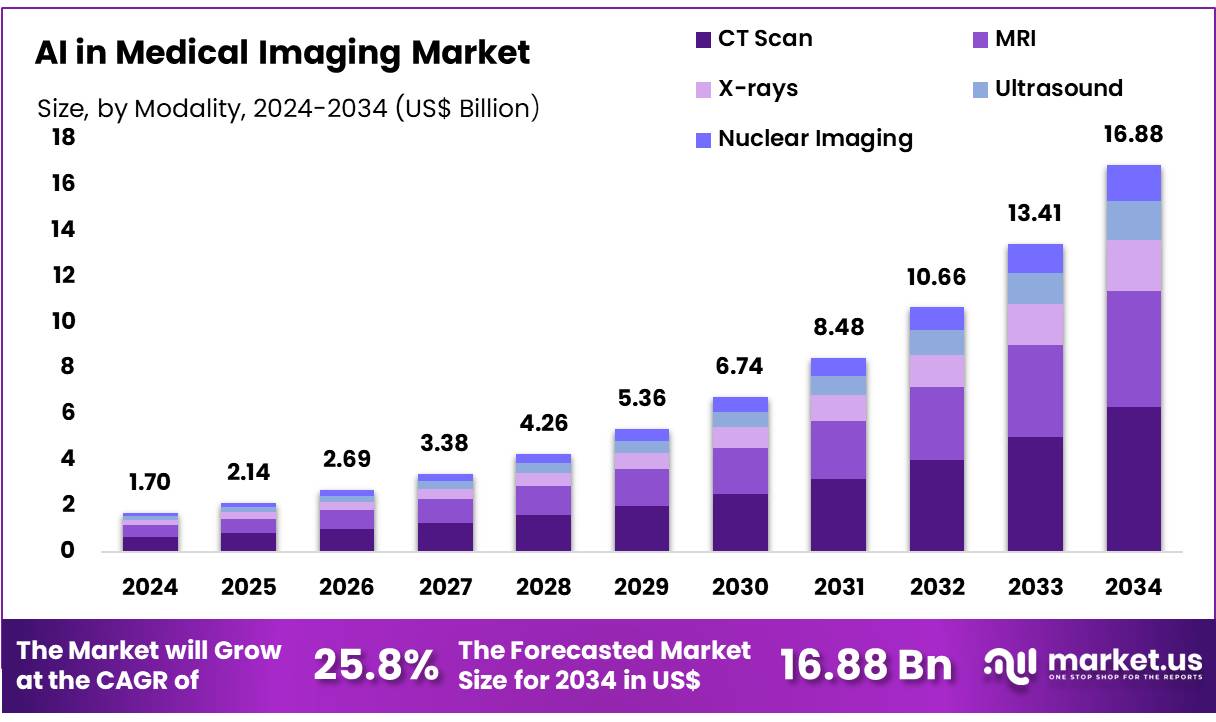
New York, NY – Dec 12, 2025 – Global AI in Medical Imaging Market size is expected to be worth around US$ 16.88 Billion by 2034 from US$ 1.70 Billion in 2024, growing at a CAGR of 25.8% during the forecast period 2025 to 2034. In 2024, North America led the market, achieving over 45.2% share with a revenue of US$ 0.77 Billion.
Artificial Intelligence (AI) is transforming the field of medical imaging by improving the accuracy, speed, and consistency of image analysis. AI in medical imaging refers to the use of advanced algorithms, particularly machine learning and deep learning models, to analyze medical images such as X-rays, CT scans, MRI scans, ultrasound images, and mammograms.
These AI systems are trained on large volumes of medical imaging data to identify patterns, anomalies, and disease indicators that may be difficult to detect through manual interpretation alone. As a result, AI supports radiologists and clinicians in disease detection, diagnosis, and treatment planning. Conditions such as cancer, cardiovascular disorders, neurological diseases, and orthopedic abnormalities are increasingly being identified at earlier stages through AI-assisted imaging tools.
The integration of AI helps reduce diagnostic errors, enhances workflow efficiency, and shortens reporting time. Automated image segmentation, image enhancement, and clinical decision support are among the key functions enabled by AI technologies. Additionally, AI-powered systems assist in managing large imaging datasets, addressing the growing demand for imaging services worldwide.
The adoption of AI in medical imaging is being driven by technological advancements, rising healthcare digitization, and the increasing burden of chronic diseases. Healthcare providers are gradually incorporating AI solutions to improve patient outcomes and optimize operational performance. Regulatory approvals and growing investments in healthcare AI are further supporting market development.
Overall, AI in medical imaging represents a significant step toward more precise, efficient, and data-driven healthcare delivery. Its continued development is expected to strengthen diagnostic capabilities and support value-based care models across global healthcare systems.
Key Takeaways
- In 2024, the AI in Medical Imaging market recorded a revenue of US$ 1.70 billion and is projected to expand at a CAGR of 25.8%, reaching an estimated value of US$ 16.88 billion by 2034.
- Based on modality, the market is categorized into CT Scan, MRI, X-rays, Ultrasound, and Nuclear Imaging, with CT Scan emerging as the leading segment, accounting for 37.4% of the market share in 2024.
- By application, the market is segmented into Neurology, Respiratory and Pulmonary, Cardiology, Breast Screening, Orthopedics, and Other Applications, where Neurology held the dominant position with a 39.8% share.
- In terms of technology, the market is divided into Deep Learning, Natural Language Processing (NLP), Machine Learning, and Other Technologies, with Deep Learning leading the segment and capturing 57.9% of the total market share.
- Regarding end use, the market is segmented into Hospitals, Diagnostic Imaging Centers, and Other End-Users. Hospitals represented the largest segment, contributing 53.7% of the overall revenue.
- North America dominated the global AI in Medical Imaging market in 2024, securing a 45.2% market share.
Regional Analysis
North America represents the leading region in the global AI in medical imaging market and is estimated to have accounted for the highest revenue share of 45.2%. This dominance is primarily attributed to the region’s well-established research and development ecosystem, particularly in medical imaging technologies. A significant number of globally recognized research institutions and universities are located in North America, supporting continuous innovation and early adoption of advanced AI solutions.
The region also benefits from a large and mature healthcare industry, which creates substantial demand for advanced medical imaging technologies. High healthcare expenditure across North America enables hospitals and diagnostic centers to invest in AI-enabled imaging systems, supporting improved diagnostic accuracy and workflow efficiency. Favorable reimbursement policies and strong regulatory frameworks further support market expansion.
In comparison, the Asia-Pacific (APAC) region is witnessing steady growth due to increasing investments in healthcare infrastructure and digital health technologies, including AI-based medical imaging solutions. Several APAC countries are actively strengthening their healthcare systems to address rising patient volumes and chronic disease prevalence. Moreover, the availability of a large pool of skilled professionals in artificial intelligence and medical imaging has accelerated the development of innovative technologies, contributing to the region’s growing presence in the global market.
Emerging Trends
- Rising Adoption Across Healthcare Providers: The adoption of artificial intelligence in medical imaging has increased steadily. As of 2023, more than 30% of radiology practices in the United States have incorporated AI-enabled tools into their diagnostic workflows, reflecting growing confidence in the technology.
- Improvement in Diagnostic Accuracy: AI-driven imaging algorithms have demonstrated high levels of accuracy, reaching up to 95% in the detection of specific conditions such as breast cancer through mammography analysis. This improvement has strengthened clinical decision-making.
- Reduction in Diagnostic Errors: The deployment of AI solutions in imaging environments has contributed to an estimated 15% reduction in diagnostic errors, supporting more reliable and consistent interpretations.
- Accelerated Image Processing: AI systems are capable of analyzing medical images up to 150 times faster than human radiologists. This acceleration significantly shortens diagnostic turnaround times and enhances patient throughput.
- Operational Cost Efficiency: The integration of AI into imaging workflows has enabled healthcare providers to achieve cost savings of up to 20% by optimizing resource utilization and reducing repeat imaging procedures.
- Enhanced Patient Outcomes: Early and precise disease detection supported by AI has contributed to approximately a 12% improvement in five-year survival rates among cancer patients.
- Increasing Regulatory Acceptance: Regulatory momentum has strengthened, with the number of FDA-cleared AI-based diagnostic imaging tools growing at an annual rate of around 35% since 2019.
- Cross-Technology Integration: AI applications in medical imaging are increasingly being integrated with complementary technologies such as digital pathology and genomics, enabling more comprehensive diagnostic insights.
- Advancement of Personalized Medicine: AI facilitates personalized healthcare by generating detailed, patient-specific diagnostic information that supports tailored treatment planning and targeted therapies.
- AI-Enabled Workflow Optimization: Automation of imaging workflows through AI has improved operational efficiency, increasing imaging center throughput by up to 25%.
- Expansion of Remote Diagnostic Capabilities: AI-powered imaging analysis supports remote diagnostics, enabling expert interpretation across geographic boundaries and improving access to care in rural and underserved regions.
- Support for Training and Clinical Education: AI tools are increasingly used in radiology training programs, enhancing diagnostic skills and supporting continuous professional development.
- Continuous Research and Innovation: Ongoing research and development efforts continue to refine AI algorithms, leading to incremental performance improvements and expanded clinical applications.
- Comprehensive Data Integration: AI imaging systems are being integrated with electronic health records (EHRs) and other healthcare data platforms, enabling holistic patient assessment and improved clinical decision-making.
- Contribution to Public Health Management: AI-based imaging plays an important role in public health initiatives by supporting early disease detection and aiding in the management of infectious disease outbreaks and health emergencies.
Key Use Cases
- Breast Cancer Detection: AI enhances breast cancer screening by accurately analyzing mammograms. For example, Google’s Lymph Node Assistant (LYNA) has demonstrated up to 99% accuracy in identifying metastatic breast cancer, significantly reducing missed diagnoses.
- Cardiovascular Disease Diagnosis: AI supports the early detection of cardiovascular conditions by automatically measuring cardiac structures and identifying abnormalities such as left atrial enlargement, aortic valve issues, and pulmonary artery changes.
- Neurological Disorder Identification: AI improves the diagnosis of neurological diseases, including Alzheimer’s disease and multiple sclerosis, by detecting subtle brain changes through advanced MRI analysis that may not be visible to the human eye.
- Cancer Screening and Early Detection: AI systems identify minute features such as microcalcifications in breast tissue or abnormalities in colon imaging, enhancing screening accuracy and reducing diagnostic variability.
- Brain Tumor Classification: AI-driven MRI analysis enables rapid and accurate brain tumor classification, achieving accuracy rates as high as 98.56% while significantly reducing diagnostic time.
- Fracture and Musculoskeletal Injury Detection: AI assists in identifying subtle fractures and musculoskeletal injuries, improving diagnostic reliability, particularly in elderly patients and complex clinical cases.
- Heart Attack Risk Prediction: By combining imaging data with clinical information, AI models predict cardiovascular event risks, allowing for earlier intervention and personalized prevention strategies.
- Surgical Planning and Outcome Optimization: AI supports preoperative planning and intraoperative guidance through advanced image analysis, contributing to reduced surgery duration and improved patient outcomes.
- Automation of Imaging Workflows: Routine imaging tasks such as measurement, analysis, and report generation are increasingly automated through AI, reducing clinician workload and mitigating burnout.
- Medical Image Quality Enhancement: AI improves image resolution and corrects artifacts, leading to clearer diagnostic images, fewer repeat scans, and reduced patient exposure to additional imaging procedures.
Frequently Asked Questions on AI in Medical Imaging
- What is AI in medical imaging?
AI in medical imaging refers to the use of machine learning and deep learning algorithms to analyze medical images, such as X-rays, MRIs, and CT scans, enabling faster detection, classification, and clinical decision support. - How does AI improve diagnostic accuracy in medical imaging?
Diagnostic accuracy is improved through AI by identifying subtle patterns often missed by human interpretation. Algorithms are trained on large datasets, enabling consistent image analysis, reduced error rates, and enhanced early disease detection. - Which medical imaging modalities commonly use AI?
AI is widely applied across imaging modalities including computed tomography, magnetic resonance imaging, ultrasound, X-ray, and nuclear imaging. CT and MRI remain dominant due to high data volume and complex image interpretation requirements. - What clinical applications benefit most from AI-based imaging?
Clinical applications benefiting most include oncology, cardiology, neurology, and orthopedics. AI assists in tumor detection, organ segmentation, disease progression tracking, and workflow optimization, improving clinical efficiency and patient outcomes. - Which regions dominate the AI in medical imaging market?
North America dominates the market due to advanced healthcare infrastructure, strong AI investment, and early technology adoption. Europe follows closely, while Asia-Pacific is experiencing the fastest growth from expanding healthcare access and innovation. - Who are the key end users in the AI medical imaging market?
Key end users include hospitals, diagnostic imaging centers, and academic research institutions. Hospitals account for the largest share due to high patient volumes, complex diagnostic needs, and increasing integration of AI-powered imaging systems. - How is regulation impacting the AI in medical imaging market?
Regulatory frameworks significantly influence market development by ensuring safety, accuracy, and transparency. Approvals from authorities such as the FDA increase market credibility, though lengthy validation processes may delay commercialization timelines. - What is the future outlook for the AI in medical imaging market?
The market outlook remains cautiously optimistic, supported by continuous algorithm improvement and expanding clinical validation. Long-term growth is expected through personalized medicine, cloud-based imaging solutions, and broader acceptance of AI-assisted diagnostics.
Conclusion
Artificial intelligence is reshaping medical imaging by enabling faster, more accurate, and more consistent diagnostic processes. The market’s strong growth outlook reflects rising clinical adoption, technological maturity, and increasing regulatory acceptance. AI-driven imaging solutions are improving early disease detection, reducing diagnostic errors, and optimizing clinical workflows across key applications such as neurology, oncology, and cardiology.
North America continues to lead due to advanced healthcare infrastructure, while Asia-Pacific shows accelerating growth. Overall, AI in medical imaging is strengthening data-driven clinical decision-making and supporting the transition toward efficient, value-based healthcare delivery worldwide.
Discuss your needs with our analyst
Please share your requirements with more details so our analyst can check if they can solve your problem(s)




