


Table of Contents
Overview
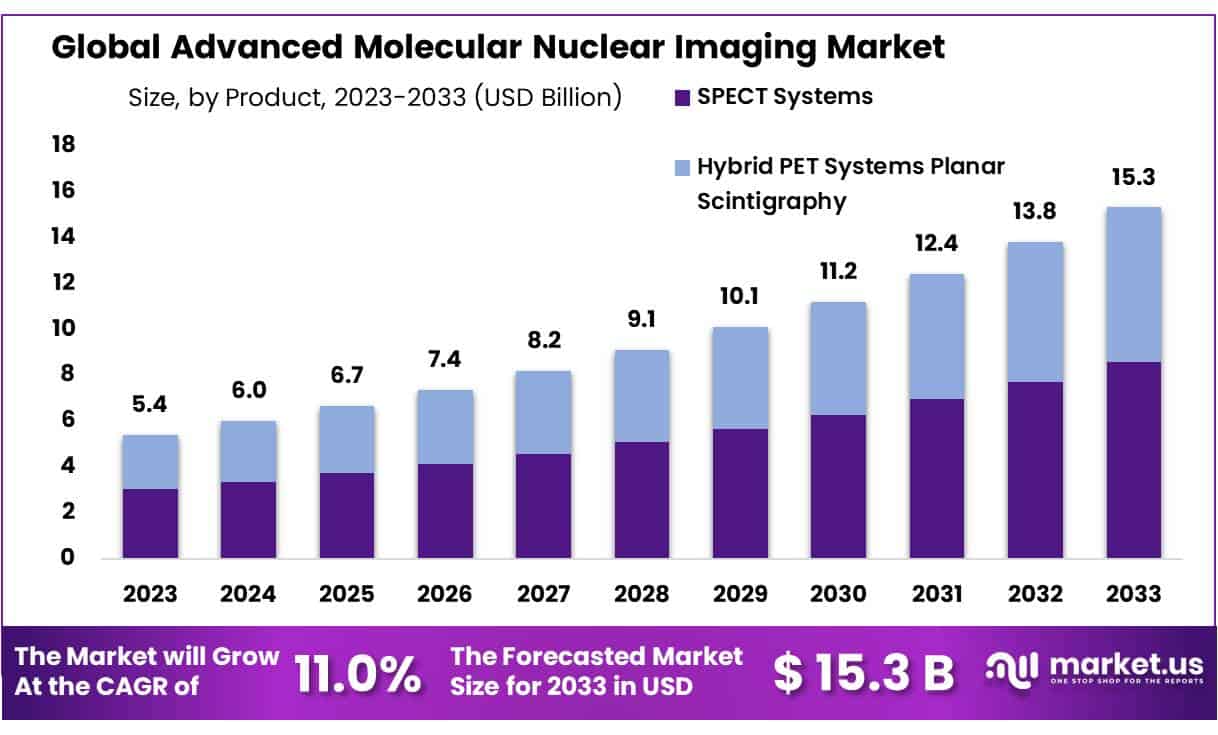
New York, NY – Feb 02, 2026 – Global Advanced Molecular Nuclear Imaging Market size is expected to be worth around USD 5.4 Billion by 2033 from USD 15.3 Billion in 2023, growing at a CAGR of 11.0% during the forecast period from 2024 to 2033.
Advanced Molecular Nuclear Imaging represents a critical evolution in diagnostic imaging, enabling the visualization of biological processes at the molecular and cellular levels. This imaging approach integrates nuclear medicine techniques with molecular biology to provide highly sensitive and quantitative insights into disease mechanisms, progression, and response to therapy.
The foundation of molecular nuclear imaging is based on the use of targeted radiopharmaceuticals. These agents are designed to bind selectively to specific cells, receptors, or metabolic pathways. Once administered, the radiopharmaceutical emits signals that are detected by specialized imaging systems such as positron emission tomography (PET) and single-photon emission computed tomography (SPECT). The resulting images allow functional and metabolic activity to be assessed rather than only anatomical structures.
The formation of advanced molecular nuclear imaging systems relies on three core components: radiotracers, detection hardware, and image reconstruction software. Radiotracers are developed through advanced chemistry and biology processes to ensure high specificity and safety. Detection systems are engineered to capture emitted gamma rays or positrons with high resolution and sensitivity. Image processing algorithms are then applied to convert raw data into clinically meaningful visual and quantitative outputs.
This technology is widely applied in oncology, cardiology, neurology, and drug development. Early disease detection, precise staging, and personalized treatment planning are supported through accurate molecular-level information. Continuous innovation in tracer development and hybrid imaging systems is expected to further enhance diagnostic accuracy and clinical value.
Advanced Molecular Nuclear Imaging is increasingly positioned as a cornerstone of precision medicine, supporting informed clinical decisions and improved patient outcomes.
Key Takeaways
- Market Size: The Advanced Molecular Nuclear Imaging Market is projected to reach approximately USD 5.4 billion by 2033, compared with USD 15.3 billion recorded in 2023.
- Market Growth: The market is anticipated to expand at a CAGR of 11.0% during the forecast period from 2024 to 2033.
- Product Analysis: SPECT systems led the market in 2023, accounting for a dominant share of about 56%.
- Application Analysis: Oncology represented the largest application segment in 2023, contributing nearly 38% of total market revenue.
- End-Use Analysis: Hospitals emerged as the leading end-use segment, capturing approximately 43% of the overall market share.
- Regional Analysis: North America maintained market leadership in 2023, holding 41.2% of the global Molecular Nuclear Imaging Market.
- Technological Advancements: Ongoing innovations, including AI-enabled analytics and advanced multi-modality imaging systems, are improving diagnostic precision and broadening clinical applications.
Regional Analysis
In 2023, North America led the molecular nuclear imaging market, accounting for 41.2% of total market share. This leadership is supported by well-established healthcare infrastructure, substantial medical research investments, and a high burden of chronic diseases requiring accurate diagnostic solutions.
Furthermore, a strong regulatory environment supports the safety and clinical effectiveness of imaging technologies, encouraging market expansion. The presence of major industry players, ongoing technological innovation, and a growing emphasis on personalized medicine and early disease detection reinforce the region’s dominant position globally.
Emerging Trends
- Integration of Theranostics: The integration of therapeutic and diagnostic functions, commonly referred to as theranostics, is increasingly shaping molecular nuclear imaging. This approach enables disease identification and treatment using the same or closely related radiopharmaceuticals. In oncology, Gallium-68–labeled peptides are widely used for tumor imaging, followed by targeted therapy with Lutetium-177–labeled compounds. This sequential strategy has demonstrated strong clinical potential, particularly in the management of neuroendocrine tumors and prostate cancer.
- Advancements in Hybrid Imaging Technologies: The adoption of hybrid imaging systems, including PET/CT and PET/MRI, continues to enhance diagnostic precision. By combining functional imaging with high-resolution anatomical detail, these platforms support more comprehensive disease assessment. Improved lesion localization and characterization have contributed to optimized treatment planning and improved patient management outcomes.
- Growing Role of Artificial Intelligence (AI): Artificial intelligence and machine learning technologies are increasingly embedded within molecular imaging workflows. These tools are being applied to image reconstruction, automated lesion detection, and quantitative analysis. AI-driven solutions improve diagnostic accuracy, reduce interpretation variability, and support personalized treatment planning, thereby strengthening clinical decision-making processes.
- Development of Novel Radiotracers: The emergence of next-generation radiotracers is expanding the diagnostic capabilities of PET imaging. Fibroblast Activation Protein Inhibitor (FAPI) tracers have shown enhanced tumor specificity and improved contrast in multiple cancer types when compared with conventional tracers such as ^18F-FDG. This development is expected to broaden clinical applications and improve detection sensitivity.
- Expansion of Multimodal Imaging Agents: Multimodal imaging agents capable of supporting multiple imaging techniques are gaining attention. These agents provide complementary biological and structural information within a single diagnostic workflow, enabling a deeper understanding of disease mechanisms and improving overall diagnostic efficiency.
Key Use Cases
- Oncology: Molecular nuclear imaging remains central to cancer diagnosis, staging, and treatment monitoring. PET imaging with ^18F-FDG is extensively used to evaluate tumor metabolism and assess therapeutic response. These capabilities support early treatment adjustments and improved patient outcomes.
- Cardiology: In cardiology, PET imaging is widely applied for myocardial perfusion assessment and the detection of coronary artery disease. Advanced tracers such as ^18F-flurpiridaz have demonstrated improved image quality and diagnostic accuracy, particularly in patient populations where conventional imaging is limited, including individuals with obesity.
- Neurology: Molecular imaging techniques are increasingly utilized in the evaluation of neurological disorders. PET imaging with amyloid-specific tracers enables visualization of beta-amyloid plaque deposition, supporting early diagnosis and disease monitoring in Alzheimer’s disease and related neurodegenerative conditions.
- Inflammatory and Infectious Diseases: Molecular nuclear imaging plays an important role in identifying and localizing inflammatory and infectious processes. PET/CT imaging enables precise detection of active disease sites, supporting targeted therapeutic interventions and improved clinical management.
Frequently Asked Questions on Advanced Molecular Nuclear Imaging
- What is advanced molecular nuclear imaging?
Advanced molecular nuclear imaging is a diagnostic technique that visualizes biological processes at the molecular and cellular levels using radiotracers, enabling early disease detection, functional assessment, and precise monitoring of treatment response. - What technologies are included in advanced molecular nuclear imaging?
The technology primarily includes PET, SPECT, and hybrid systems such as PET/CT and PET/MRI, which combine functional molecular data with anatomical imaging to improve diagnostic accuracy and clinical decision-making. - What are the main clinical applications of advanced molecular nuclear imaging?
It is widely used in oncology, cardiology, and neurology for tumor detection, staging, cardiac perfusion analysis, and neurodegenerative disease evaluation, supporting early diagnosis and personalized treatment planning. - What are the key advantages of molecular nuclear imaging over conventional imaging?
The key advantages include high sensitivity, ability to detect diseases at an early molecular stage, quantitative analysis of biological activity, and improved accuracy in therapy monitoring compared with purely anatomical imaging techniques. - What factors are driving the growth of the advanced molecular nuclear imaging market?
Market growth is driven by rising cancer prevalence, increasing demand for early and accurate diagnosis, technological advancements in hybrid imaging systems, and expanding adoption of personalized and precision medicine globally. - How is the market segmented by product and application?
The market is segmented by imaging systems, radiopharmaceuticals, and software, while key application areas include oncology, cardiology, neurology, and research, with oncology accounting for the largest revenue share. - Which regions dominate the advanced molecular nuclear imaging market?
North America dominates due to strong healthcare infrastructure and high technology adoption, while Asia-Pacific is expected to witness the fastest growth, supported by expanding healthcare investments and increasing diagnostic awareness.
Conclusion
Advanced Molecular Nuclear Imaging has emerged as a transformative pillar of modern diagnostic medicine, enabling precise visualization of disease at molecular and cellular levels. Its integration of targeted radiopharmaceuticals with PET, SPECT, and hybrid imaging systems supports early detection, accurate staging, and personalized treatment planning across oncology, cardiology, and neurology.
Market growth is being driven by rising chronic disease burden, technological innovation, and expanding adoption of precision medicine. Continued advancements in AI, novel tracers, and theranostic approaches are expected to further enhance clinical value, reinforcing the long-term importance of molecular nuclear imaging in global healthcare systems.
Discuss your needs with our analyst
Please share your requirements with more details so our analyst can check if they can solve your problem(s)




