


Table of Contents
Overview
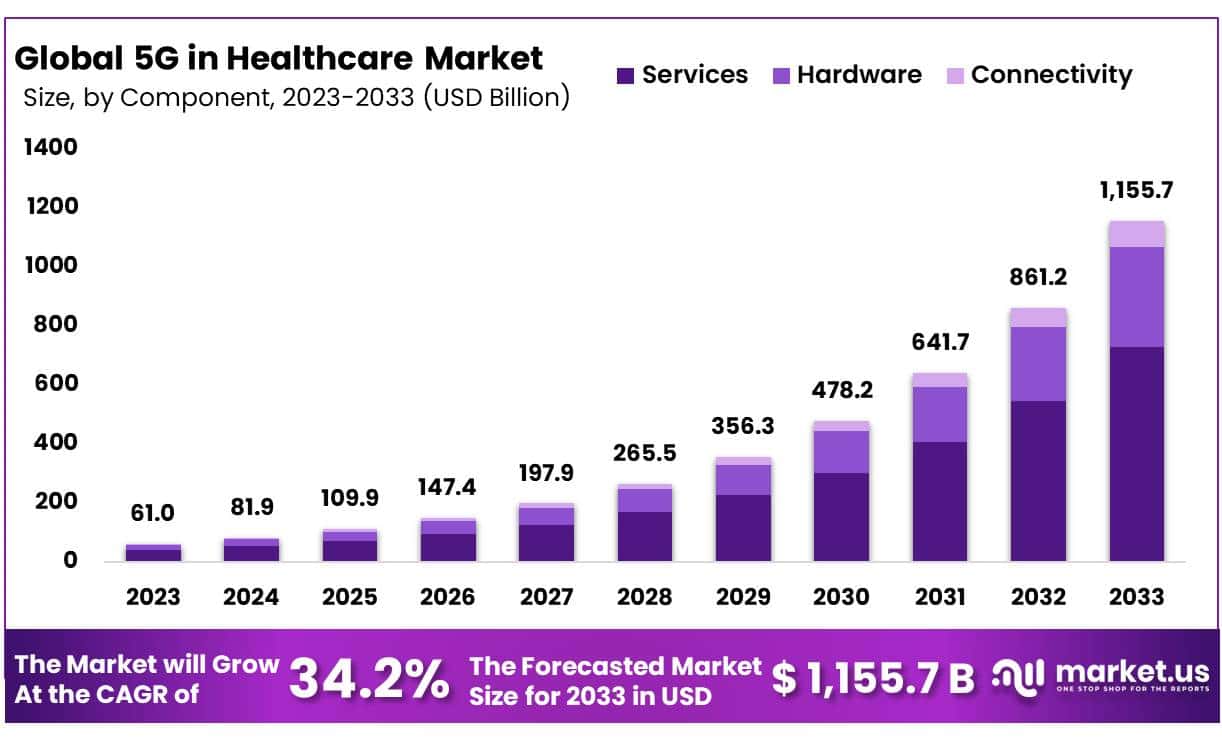
New York, NY – Dec 29, 2025 – The Global 5G in Healthcare Market size is expected to be worth around USD 1,155.7 Billion by 2033 from USD 81.9 Billion in 2024, growing at a CAGR of 34.2% during the forecast period from 2024 to 2033.
The integration of 5G technology in healthcare is shaping a new foundation for connected, data-driven medical services. With ultra-low latency, high bandwidth, and improved network reliability, 5G enables faster data transmission and real-time connectivity across healthcare ecosystems. This advancement is supporting the delivery of more efficient, precise, and patient-centric care.
The deployment of 5G networks is enhancing critical applications such as remote patient monitoring, telemedicine, and connected medical devices. High-speed connectivity allows continuous transmission of large medical data files, including imaging and diagnostics, without disruption. As a result, clinical decision-making can be improved through timely access to accurate patient information.
5G is also strengthening the adoption of advanced technologies such as artificial intelligence, augmented reality, and robotic-assisted procedures. These solutions rely on stable and high-capacity networks to function effectively, particularly in time-sensitive medical environments. The improved performance of 5G networks is enabling healthcare providers to expand virtual consultations and remote interventions, improving access to care in underserved and rural regions.
From an operational perspective, healthcare facilities are benefiting from improved asset tracking, smart hospital infrastructure, and optimized workflow management. The growth of connected systems is contributing to cost efficiencies and better resource utilization across hospitals and clinics.
Overall, the adoption of 5G in healthcare is expected to support improved clinical outcomes, enhanced patient experiences, and long-term system efficiency. The technology is positioned as a key enabler in the ongoing digital evolution of the global healthcare sector.
Key Takeaways
- By component, the services segment captured a substantial revenue share of 63.2%, emerging as the leading contributor to the global 5G in healthcare market in 2023.
- By application, the connected medical devices segment accounted for a significant market share of 58.4%, driven by its role in transforming patient care delivery and modern treatment approaches.
- By end user, the healthcare providers segment maintained market leadership, holding a dominant share of 61.3% of the global 5G in healthcare market.
- Regionally, North America remained at the forefront of the global 5G in healthcare market in 2023, supported by advanced digital infrastructure and early technology adoption.
- The rapid expansion of 5G-enabled remote patient monitoring is strongly reinforcing the growth trajectory of the global 5G in healthcare market.
- However, market growth may face potential constraints due to privacy and security concerns, as risks related to breaches of sensitive patient data continue to pose challenges.
Regional Analysis
North America remained the leading region in the global 5G in healthcare market, accounting for a significant revenue share of 39.6% in 2023. The region’s strong market position is supported by multiple contributing factors that continue to drive industry expansion. Key growth drivers include the rising prevalence of coronary artery disorders (CAD), an expanding geriatric population, and continuous innovation through new product launches by major healthcare and technology companies.
According to the Centers for Disease Control and Prevention (CDC), nearly 20 million individuals in the United States were affected by coronary artery disease in 2020, highlighting the increasing demand for advanced healthcare solutions such as 5G-enabled remote monitoring and connected medical systems. These technologies are playing an essential role in improving disease management and clinical outcomes across the region.
In contrast, the Asia-Pacific region is projected to witness substantial growth over the forecast period. Market expansion in this region is primarily driven by the increasing availability of 5G-enabled medical devices and strong government initiatives aimed at integrating 5G technology into healthcare systems. Additionally, rapid adoption of advanced digital technologies, rising deployment of IoT-enabled medical equipment, continuous improvements in network infrastructure, and supportive government programs for IoT development are collectively accelerating regional market growth.
Emerging trends
- Private 5G networks inside hospitals are rising (better control than public mobile networks)
- Dedicated “campus” 5G is being deployed so that coverage, speed, and security can be controlled inside a hospital site.
- In Germany, 100 MHz in the 3.7–3.8 GHz band was opened for local 5G licences (often called campus networks).
- In the UK, local/shared access licensing also includes 3.8–4.2 GHz, with published licence fees (for example, 100 MHz = £800/year in rural areas in Ofcom’s fee table).
- Remote diagnosis from ambulances is moving from trials to repeatable use cases
- 5G is being used to send high-quality medical data while the patient is in transit, so that hospital specialists can support paramedics in real time.
- A UK connected ambulance ultrasound case study reported speeds up to 1 Gbps and described ultrasound image transfers “in seconds,” enabling real-time remote guidance.
- The same case study states the hospital trust involved undertakes 113,500 ambulance conveyances per year, showing the scale of the care pathway where 5G-enabled support can be applied.
- Low-latency + high-reliability “slices” are becoming a healthcare requirement (not a nice-to-have)
- For time-sensitive care (for example, connected devices and remote procedures), the network must behave predictably, not only fast.
- ITU-R minimum technical targets for IMT-2020 include user-plane latency of 1 ms for URLLC and reliability of 1–10⁻⁵ (success probability) for sending a small packet within 1 ms under defined test conditions.
- These targets are driving adoption of 5G features such as quality-of-service control and dedicated capacity for clinical traffic (often implemented through slicing and policy controls).
- “More sensors per patient” is expanding (Internet of Medical Things), and 5G is used to carry the load
- More clinical-grade and home monitoring devices are being connected at the same time, increasing the need for stable wireless capacity.
- IMT-2020 minimum targets include connection density of 1,000,000 devices per km², supporting high device concentrations where many sensors and devices operate together.
- IMT-2020 also sets expectations such as at least 100 MHz bandwidth capability (and up to 1 GHz in higher bands), which supports high total data movement when many devices are active.
- Edge computing is being adopted to keep clinical data processing close to the care site
- In many clinical workflows, delays are created when data must travel to a far-away cloud and back.
- Multi-access Edge Computing (MEC) is defined by ETSI as bringing cloud-computing capabilities to the edge of the network, characterized by ultra-low latency and high bandwidth, which is a strong fit for imaging support, alarms, and real-time decision tools.
- This trend is being strengthened by the practical latency targets expected from 5G (for example, 1 ms URLLC user-plane target in IMT-2020 evaluation requirements).
- Telemedicine demand is staying structurally higher than pre-pandemic levels, and 5G is used to improve quality (video + device data)
- The care model is continuing to shift toward remote-first pathways for selected conditions, which increases the need for reliable mobile connectivity.
- In the United States, the CDC reported adult telemedicine use of 37.0% (2021) and 30.1% (2022) (telemedicine use in the past 12 months).
- As telemedicine becomes routine, more visits are being supported by continuous data streams (vitals, images, device readings), which increases the value of lower latency and higher uplink performance.
- Security risk management is becoming stricter as more patient monitors go online
- As medical devices connect through IP networks (including via 5G routers/private 5G), cybersecurity is being treated as a patient-safety issue.
- A Reuters report described the U.S. FDA identifying cybersecurity vulnerabilities in certain patient monitors, including risks of unauthorized access and potential exposure of sensitive patient data once connected to the internet.
- This is pushing hospitals toward tighter device onboarding, network segmentation, and continuous monitoring—often easier to enforce in private 5G than in open Wi-Fi environments.
Use Cases
Real-Time Remote Patient Monitoring: 5G enables continuous monitoring of patients outside traditional clinical settings by supporting a large number of connected wearable devices and sensors. These devices can send vital signs (e.g., heart rate, blood glucose, blood pressure) in real time to healthcare providers with ultra-low latency and high reliability. This reduces the need for frequent in-person visits and supports proactive care management for chronic diseases.
Connected Ambulance and Emergency Services: 5G connectivity transforms emergency response by enabling ambulances to become mobile diagnostic and communication hubs. Vital patient data and high-quality video feeds can be streamed directly to hospital teams as the ambulance approaches. This enhances early assessment and decision-making in critical cases such as stroke or trauma.
Telehealth and High-Definition Virtual Consultations: Telemedicine services are enabled at a higher scale and quality with 5G. High-definition (HD) video consultations can be conducted with minimal buffering and enhanced reliability, improving diagnosis accuracy in specialties like dermatology and wound care. 5G’s greater bandwidth and consistent quality of service makes these interactions smoother than prior cellular technologies.
Remote Robotic Surgery and Expert Collaboration: One of the most transformative use cases is remote surgery where surgeons control robotic instruments from remote locations. 5G’s ultra-reliable low-latency communication (URLLC) is critical for synchronizing actions in real time. This capability supports remote expert collaboration across facilities and can democratize access to surgical expertise.
Smart Hospital Operations and Internet of Medical Things (IoMT): 5G supports a dense ecosystem of connected devices inside smart hospitals, including infusion pumps, trackers for medical equipment, automated kiosks, and asset management systems. The network’s capacity to handle thousands of IoMT devices per square kilometre allows real-time tracking, automated workflows, and enhanced operational efficiency.
Augmented Reality (AR) and Virtual Reality (VR) in Training and Treatment: With 5G’s high data throughput and low latency, immersive AR/VR environments can be used for medical training, remote consultation, and guided procedures. This is especially valuable for complex operations or educational programs that require high-resolution imaging and interaction without perceptible lag.
Frequently Asked Questions on 5G in Healthcare
- How does 5G improve telemedicine services?
5G improves telemedicine by supporting real-time, high-definition video consultations with minimal latency. This enables accurate remote diagnosis, enhanced patient–doctor interaction, and improved access to healthcare services, particularly in remote and underserved regions. - What role does 5G play in remote patient monitoring?
5G enables continuous and real-time transmission of patient health data from connected medical devices. This supports proactive clinical decision-making, early detection of health issues, and reduced hospital readmissions through efficient remote monitoring systems. - How does 5G support advanced medical procedures?
5G supports advanced procedures such as robotic-assisted surgery and augmented reality-guided interventions by providing ultra-reliable and low-latency connectivity. This ensures precise control, real-time feedback, and improved surgical outcomes in complex clinical environments. - Is 5G technology secure for healthcare data?
5G networks incorporate advanced encryption, network slicing, and authentication mechanisms. These features enhance data security and privacy, making 5G suitable for handling sensitive healthcare information while complying with regulatory and data protection standards. - What factors are driving the growth of the 5G in healthcare market?
Market growth is driven by increasing demand for telehealth services, rising adoption of connected medical devices, advancements in digital health infrastructure, and the need for faster, more reliable communication networks across healthcare systems. - Which applications contribute most to market demand?
Key applications include remote patient monitoring, telemedicine, connected ambulances, robotic surgery, and smart hospitals. These segments generate significant demand due to their reliance on real-time data transmission and low-latency network performance. - What is the future outlook for the 5G in healthcare market?
The market outlook remains cautiously optimistic, supported by ongoing investments in digital health and network infrastructure. Widespread adoption is expected as costs decline, regulations mature, and healthcare systems increasingly prioritize connected and data-driven care models.
Conclusion
The integration of 5G technology is establishing a robust foundation for connected, data-driven healthcare delivery. With ultra-low latency, high bandwidth, and reliable connectivity, 5G is enabling real-time clinical decision-making, advanced remote care, and efficient hospital operations. Its role in supporting telemedicine, remote patient monitoring, connected ambulances, and smart hospitals is strengthening care quality and accessibility.
While privacy and cybersecurity remain key considerations, ongoing network innovation and regulatory focus are addressing these risks. Overall, 5G is positioned as a critical enabler of improved clinical outcomes, operational efficiency, and long-term digital transformation across global healthcare systems.
Discuss your needs with our analyst
Please share your requirements with more details so our analyst can check if they can solve your problem(s)




