


Table of Contents
Overview
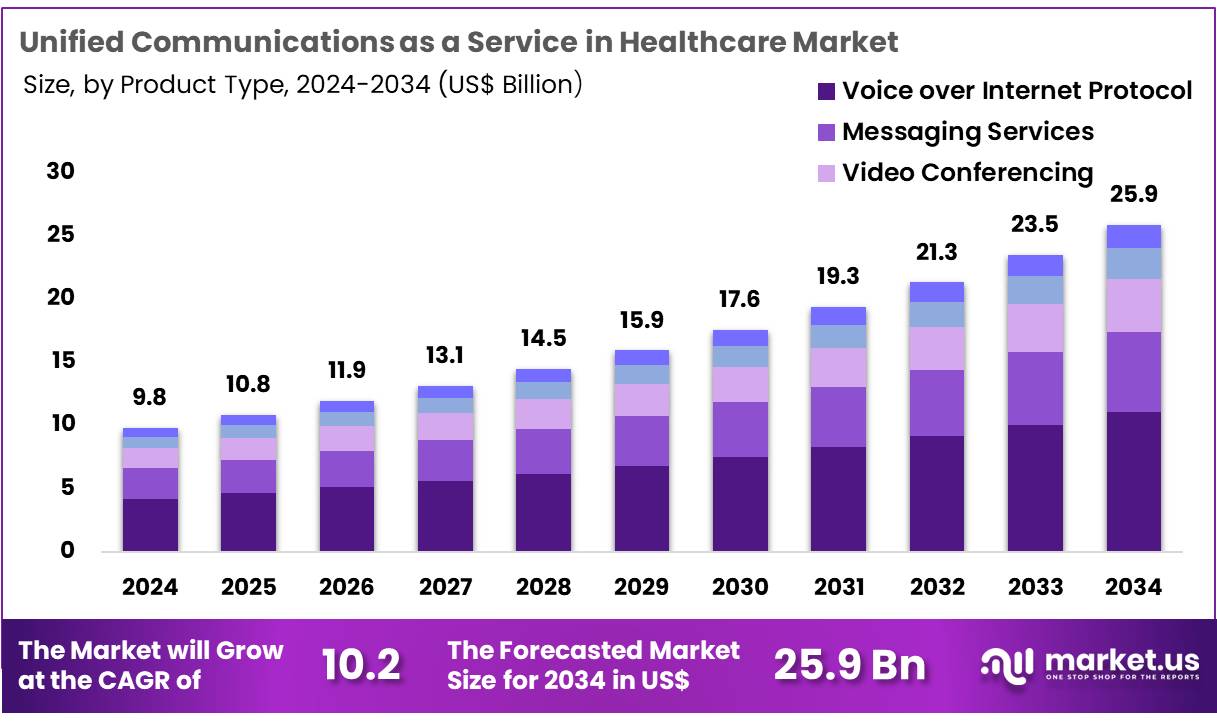
New York, NY – Dec 04, 2025 – Global Unified Communications as a Service in Healthcare Market size is expected to be worth around US$ 25.9 Billion by 2034 from US$ 9.8 Billion in 2024, growing at a CAGR of 10.2% during the forecast period 2025 to 2034. In 2024, North America led the market, achieving over 42.6% share with a revenue of US$ 4.2 Billion.
The adoption of Unified Communications as a Service (UCaaS) in the healthcare sector has been expanding as providers continue to prioritize integrated communication, patient engagement, and operational efficiency. The market has been supported by rising demand for cloud-based communication platforms that enable secure messaging, telemedicine, clinical collaboration, and workflow automation. The growth of UCaaS in healthcare has been driven by the need to reduce communication silos, strengthen care coordination, and improve the overall patient experience.
A shift toward digital health and remote care delivery has accelerated the deployment of UCaaS solutions across hospitals, clinics, and specialty care centers. Cloud-enabled platforms have allowed healthcare organizations to centralize voice, video, messaging, and conferencing tools under a single interface, which has resulted in streamlined operations and reduced administrative burden. The increasing emphasis on data security and compliance has further supported the use of UCaaS solutions designed to meet HIPAA and other regulatory standards.
The rising pressure on healthcare systems to enhance productivity and optimize resource utilization has encouraged investments in scalable and cost-efficient communication technologies. The integration of UCaaS with electronic health records, telehealth portals, and mobile health applications has been widely observed, enabling real-time collaboration and faster clinical decision-making.
Ongoing technological advancements, including AI-driven communication and automation capabilities, are expected to reinforce market expansion. The UCaaS in healthcare market is projected to demonstrate steady growth as providers continue to modernize communication infrastructure and adopt cloud-based collaboration tools to support high-quality patient care.
Key Takeaways
- In 2024, the unified communications as a service (UCaaS) market in healthcare generated US$ 9.8 billion in revenue, recorded a CAGR of 10.2%, and is projected to reach US$ 25.9 billion by 2034.
- The product type segment comprises voice over internet protocol (VoIP), messaging services, video conferencing, contact center services, and call management, with VoIP leading in 2024 by capturing 42.8% of the market share.
- Based on technology, the market is categorized into public, hybrid, and private models, where the hybrid segment accounted for the largest share at 52.1%.
- In terms of application, the market is segmented into telemedicine, collaboration tools, patient engagement, workforce management, and healthcare analytics, with telemedicine emerging as the dominant segment, holding 47.6% of the total revenue.
- The end-user segment includes hospitals & clinics, health insurance providers, pharmaceuticals, and diagnostic laboratories, with hospitals & clinics leading the market by securing 58.9% of the revenue share.
- North America dominated the UCaaS in healthcare market, achieving a 42.6% share in 2024.
Regional Analysis
North America accounted for 42.6% of the Unified Communications as a Service (UCaaS) in healthcare market, supported by rising demand for improved care coordination and growing remote work, which reached 19.9% in the US by July 2023. Emphasis on interoperability by the ONC has further driven adoption, as UCaaS platforms enable secure, seamless communication and enhance patient engagement.
Asia Pacific is projected to record the fastest CAGR due to rapid digital transformation and expanding cloud adoption. APEC notes digital economy growth above 15% annually, with India and China accelerating digital health initiatives. Strengthening digital infrastructure, large patient populations, and increased use of telehealth are driving demand for scalable UCaaS solutions across the region.
Emerging Trends
- Accelerated Adoption of Telehealth: The adoption of cloud-enabled communication platforms has been driven by the rapid expansion of telehealth services. The proportion of office-based physicians utilizing telemedicine increased from 15.4% in 2019 to 86.5% in 2021. This shift toward virtual care has reinforced the demand for UCaaS solutions that support video consultations, secure messaging, and digital appointment management.
- Growth of Remote Mental Health Services in Rural Regions: Cloud-delivered communication tools have supported an expansion of remote mental health care, particularly in underserved rural areas. In 2021, approximately 80% of rural Medicare telehealth visits were associated with mental health conditions. UCaaS platforms have enabled these interactions by delivering secure audio, video, and chat functionalities where in-person services are often limited.
- Increased Use of Secure Messaging in Hospitals: Hospitals have demonstrated strong engagement in secure electronic communication to coordinate clinical activities. By 2021, around 41% of U.S. hospitals enabled providers to send and receive secure patient messages, while participation in Direct secure messaging networks reached 90%. This trend highlights UCaaS’s expanding role in supporting interoperability and timely information exchange.
- Deepening Integration with Electronic Health Records (EHRs): The operational value of UCaaS has been strengthened through tighter integration with EHR systems. By the end of 2021, more than 60% of hospitals were actively sharing clinical data with external providers at the point of care. Embedding communication tools such as click-to-call and built-in video within EHR interfaces has simplified workflows and reduced administrative burden for clinicians.
- Heightened Emphasis on Security and Compliance: The ongoing shift to cloud-based communication has intensified the focus on data protection and regulatory compliance. UCaaS vendors increasingly provide HIPAA-compliant encryption, multi-factor authentication, and detailed audit logging. These enhancements ensure the safeguarding of patient information across voice, video, and messaging channels and address growing cybersecurity concerns.
Use Cases
- Virtual Patient Consultations: Healthcare providers conduct remote visits through video conferencing tools, reducing travel barriers and expanding access to care. In 2021, 86.5% of office-based physicians incorporated telemedicine into patient interactions.
- Secure Patient Communication: UCaaS platforms support encrypted patient messaging, allowing individuals to exchange health-related information securely. More than 60% of hospitals offered secure electronic messaging capabilities in 2021.
- Provider-to-Provider Electronic Consultations: Specialty consultations are increasingly facilitated through secure messaging channels, enabling clinicians to obtain expert input without requiring in-person referrals. Participation in Direct secure messaging networks reached 90% of hospitals in 2021.
- Cross-Facility Care Coordination: Health systems operating across multiple sites employ UCaaS-based voice, video, and group chat tools to coordinate patient transfers and share updates. By 2023, hospitals frequently sending information to external providers increased to 84%.
- Emergency and Mass Notification Systems: UCaaS solutions support real-time dissemination of critical alerts including code blue notifications, public health advisories, and disaster response messages via SMS, voice, or email. Integration with incident command systems ensures timely communication across clinical teams and departments.
Frequently Asked Questions on Unified Communications as a Service in Healthcare
- How does UCaaS improve patient care?
UCaaS improves patient care by enabling real-time communication across clinical teams, supporting virtual consultations, and ensuring rapid information exchange. These capabilities reduce delays, streamline decision-making, and create more coordinated care pathways that enhance overall patient satisfaction and outcomes. - What security features are required for healthcare UCaaS?
Healthcare UCaaS requires encryption, identity management, audit controls, and HIPAA-compliant data handling. These safeguards ensure that sensitive patient information is protected across communication channels, reducing cybersecurity risks and ensuring regulatory adherence throughout digital interactions. - How does UCaaS support telehealth services?
UCaaS supports telehealth by integrating video conferencing, secure messaging, and digital appointment management. These tools allow clinicians to engage patients remotely, expand access to care, and improve service delivery efficiency without compromising confidentiality or communication quality. - What is driving growth in the healthcare UCaaS market?
Market growth is being driven by rising demand for telehealth, increased digital transformation, cost-efficient communication models, and the need for improved clinical coordination. These factors are accelerating UCaaS adoption across hospitals, clinics, and remote care environments. - Which regions are experiencing the fastest UCaaS market expansion?
North America and Europe are experiencing strong adoption due to advanced healthcare infrastructure and regulatory support, while Asia-Pacific shows rapid expansion driven by digital health investments, increasing cloud readiness, and growing emphasis on accessible communication technologies. - What technologies are influencing market evolution?
AI-powered communication tools, advanced analytics, cloud interoperability, and secure messaging platforms are influencing market evolution. These innovations enhance automation, enable predictive workflows, and support more efficient communication strategies across diverse healthcare delivery systems. - Who are the key players in the healthcare UCaaS market?
Key players include Cisco, Microsoft, RingCentral, Zoom, and 8×8. Their platforms offer integrated communication capabilities tailored to healthcare organizations, enabling enhanced collaboration, secure data exchange, and scalable solutions aligned with evolving clinical communication needs.
Conclusion
The UCaaS in healthcare market is expected to maintain steady long-term expansion as providers modernize communication systems to support high-quality, coordinated care. Growth has been driven by increasing adoption of telehealth, secure messaging, workflow automation, and integrated collaboration tools that enhance clinical efficiency and patient engagement.
The market is further supported by strong emphasis on regulatory compliance, rising cloud readiness, and expanding digital health initiatives across major regions. Continued advancements in AI-enabled communication, interoperability, and data security are anticipated to reinforce adoption, positioning UCaaS as a central component of future healthcare delivery and operational optimization.
Discuss your needs with our analyst
Please share your requirements with more details so our analyst can check if they can solve your problem(s)




