


Table of Contents
Overview
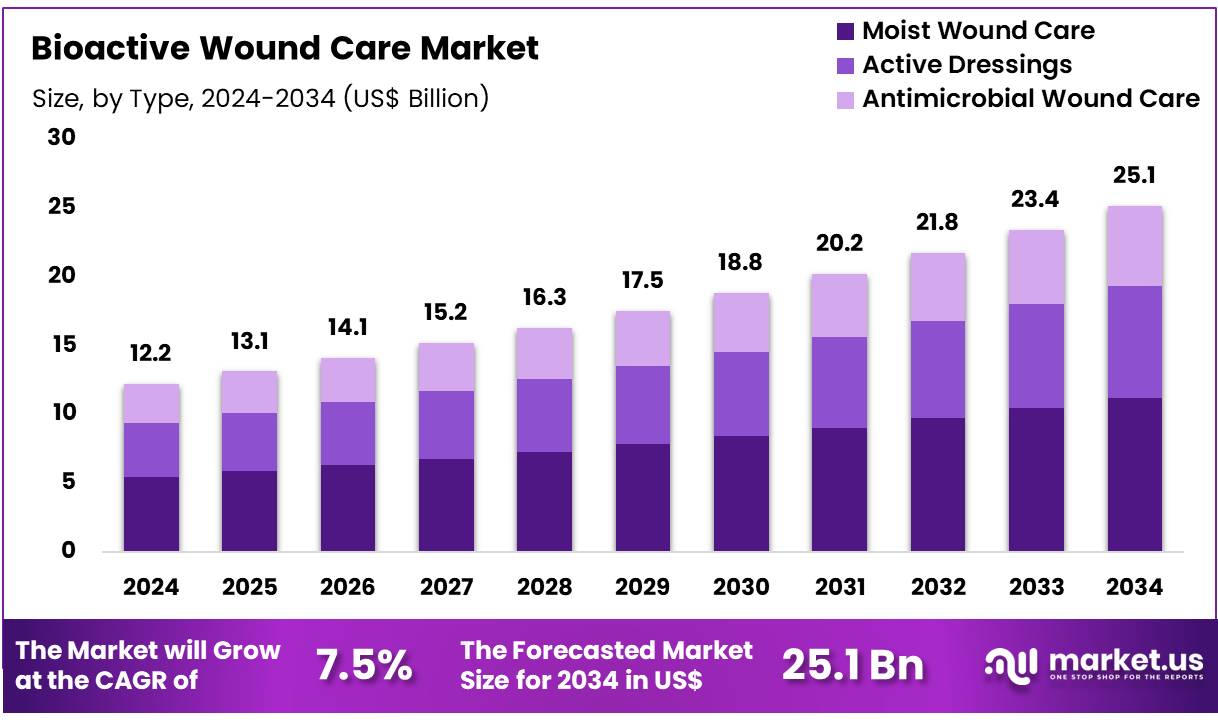
New York, NY – Dec 09, 2025 – Global Bioactive Wound Care Market size is expected to be worth around US$ 25.1 Billion by 2034 from US$ 12.2 Billion in 2024, growing at a CAGR of 7.5% during the forecast period 2025 to 2034. In 2024, North America led the market, achieving over 43.4% share with a revenue of US$ 5.3 Billion.
The emergence of bioactive wound care solutions has been characterized as a significant advancement in modern clinical treatment. The development of these products has been driven by the growing need for effective therapies that accelerate healing, prevent infections, and reduce the overall burden of chronic wounds. Bioactive wound care technologies are designed to interact with the wound environment, and their efficacy has been strengthened by the integration of antimicrobials, growth factors, and biologically active compounds.
The demand for these advanced therapies has been supported by the rising incidence of diabetes, pressure ulcers, burns, and surgical wounds. The adoption of bioactive dressings has been encouraged in hospitals and specialty clinics as they provide enhanced moisture balance, improved cellular activity, and faster tissue regeneration. The growth of the market has been further influenced by continuous innovation in biomaterials, such as collagen, alginate, hydrogel, and chitosan, which have demonstrated high compatibility with human tissue.
Significant investments in research and development have been observed, and strategic collaborations among medical device companies, biotechnology firms, and research institutions have strengthened product pipelines. Regulatory approvals for novel dressings and biologics have expanded the availability of next-generation solutions for complex wound management.
The outlook for bioactive wound care remains positive, and the market is expected to record stable growth as awareness increases and healthcare systems shift toward evidence-based advanced wound management. Bioactive wound care technologies are positioned to become essential components in improving patient outcomes and reducing treatment costs across global healthcare settings.
Key Takeaways
- The bioactive wound care market generated US$ 12.2 billion in revenue in 2024 and is projected to reach US$ 25.1 billion by 2034, supported by a CAGR of 7.5%.
- Moist wound care emerged as the leading product type in 2024, accounting for 44.6% of the market.
- General surgery represented the dominant application segment, capturing 60.3% of the total market share.
- North America remained the largest regional market, contributing 43.4% of global revenue in 2024.
Regional Analysis
North America accounted for the largest share of the Bioactive Wound Care Market, representing 43.4% of total revenue. The growth of the regional market can be attributed to the high prevalence of chronic wounds, strong advancements in regenerative medicine, and elevated healthcare expenditure.
According to the National Center for Biotechnology Information, an estimated 1.0 to 3.0 million individuals in the U.S. experience pressure injuries each year, and nearly 5.0% of diabetic patients develop foot ulcers. These factors have increased the demand for bioactive and advanced wound care solutions. Regulatory support has further strengthened the market; in August 2022, Organogenesis Holdings Inc. received U.S. FDA 510(k) clearance for PuraPly MZ. The company recorded US$453.6 million in net revenue from Advanced Wound Care products in 2024, reflecting a 12% annual increase.
Asia Pacific is projected to register the fastest CAGR during the forecast period. The expansion of this region is driven by the aging population, rising incidence of diabetes, and increasing healthcare spending, supported by greater awareness of advanced wound management. Governments, particularly in Japan, are encouraging innovation in regenerative medicine. Global leaders such as Smith+Nephew are also expanding their presence, indicating sustained demand for sophisticated wound healing technologies across Asia Pacific.
Emerging Trends
- Smart and Multifunctional Dressings: The adoption of smart materials and embedded sensor technologies in bioactive dressings is increasing. These advanced systems have been designed to monitor critical wound parameters such as pH, temperature, moisture levels, and biomarker fluctuations. Real-time data support early detection of infection and delayed healing, thereby improving clinical decision-making. Personalized approaches, including patient-specific incorporation of growth factors or antimicrobial agents, are also emerging as a significant trend in advanced wound care.
- Nanotherapeutics and Bioengineered Scaffolds: Nanoparticle-enabled therapies are being integrated into wound dressings to facilitate targeted delivery of drugs, growth factors, and genetic materials. Silver and zinc oxide nanoparticles are being utilized for their antimicrobial activity, while lipid-based nanocarriers provide controlled release of regenerative agents. Simultaneously, advancements in 3D bioprinting are enabling the fabrication of bioengineered scaffolds with precise architecture and embedded cells or signaling molecules, supporting enhanced tissue regeneration.
- Oxygen-Releasing and Hypoxia-Mitigating Materials: Chronic wounds often exhibit hypoxic conditions (pO₂ < 30 mmHg), which limit collagen formation and angiogenesis. Innovative biomaterials capable of releasing or generating oxygen through chemical or photosynthetic mechanisms are gaining prominence. These dressings maintain oxygen levels above critical thresholds, thereby promoting cellular proliferation and vascularization, which are essential for the healing of non-responsive wounds.
Use Cases
- Diabetic Foot Ulcers (DFU): It is estimated that nearly 12% of individuals with diabetes develop a foot ulcer during their lifetime, facing high risks of infection and potential amputation. Ulcers typically remain unhealed after 30 days without intervention. Bioactive dressings containing growth factors, antimicrobial nanoparticles, or oxygen-releasing compounds have demonstrated up to a 40% improvement in healing rates, with a corresponding reduction in amputation risk due to enhanced tissue regeneration and microbial control.
- Pressure Ulcers in Long-Term Care: Approximately 11% of residents in U.S. nursing homes present with at least one pressure ulcer, with Stage 2 ulcers occurring most frequently. Only 35% of these patients receive specialized wound management. Bioactive hydrogel dressings formulated with collagen, hyaluronic acid, or antimicrobial agents have been associated with faster healing and reduced progression to more severe stages. Early application of these dressings has been shown to shorten healing time by up to 20%.
- Acute Traumatic and Burn Wounds: Bioactive hydrogel dressings accelerate recovery in partial- and full-thickness burn injuries. Evidence indicates a reduction in healing time by an average of 5.3 days when compared to standard gauze. These dressings create a moist healing environment, provide antimicrobial protection, and can be loaded with agents that reduce pain and inflammation, improving overall clinical outcomes.
Frequently Asked Questions on Bioactive Wound Care
- How do bioactive wound dressings work?
Bioactive wound dressings function by creating an optimal healing environment through moisture regulation, cell stimulation, and antimicrobial actions. These dressings typically include agents like collagen, growth factors, or antimicrobial compounds that accelerate tissue repair while minimizing complications such as inflammation and infection. - What types of bioactive wound care products exist?
Bioactive wound care products include collagen dressings, hydrogel-based formulations, alginate dressings, antimicrobial dressings, and skin substitutes. These products are used for chronic, surgical, and traumatic wounds due to their ability to support biological healing and stabilize damaged tissue. - What conditions are treated using bioactive wound care?
Bioactive wound care is primarily used to treat diabetic ulcers, venous leg ulcers, pressure injuries, burns, and postoperative wounds. These conditions benefit from therapies that enhance cell activity, manage exudate, reduce contamination, and support stronger tissue regeneration in compromised wound environments. - What benefits do bioactive wound products offer?
Bioactive wound products offer advantages such as faster healing, reduced infection rates, enhanced moisture control, and improved patient comfort. Their biological activity helps stimulate natural repair mechanisms, making them superior to conventional dressings for complex or slow-healing wounds. - What is driving growth in the bioactive wound care market?
Growth in the bioactive wound care market is driven by rising incidences of chronic wounds, an aging population, increasing prevalence of diabetes, and accelerating demand for advanced wound healing solutions. Strong innovation pipelines and healthcare investments further support positive market expansion globally. - Which regions dominate the bioactive wound care market?
North America dominates the bioactive wound care market due to advanced healthcare infrastructure, high chronic wound cases, and rapid adoption of innovative therapies. Europe follows closely, while Asia-Pacific is experiencing rapid growth as healthcare expenditure and chronic disease rates increase. - How is technology influencing the bioactive wound care market?
Technology is influencing the market through innovations in biomaterials, nanotechnology, and smart dressings that monitor healing conditions. These advancements enhance product performance, enable improved patient management, and support the growing shift toward evidence-based wound care globally.
Conclusion
The bioactive wound care market is expected to maintain steady growth as demand strengthens for advanced solutions capable of accelerating healing and reducing chronic wound complications. Expansion has been supported by rising diabetes prevalence, aging populations, and continuous innovation in biomaterials, nanotechnology, and smart dressings.
North America continues to lead the market, while Asia Pacific is projected to grow rapidly due to improving healthcare infrastructure and increasing awareness. Strategic collaborations, regulatory approvals, and investment in research have strengthened product pipelines. As evidence-based wound management expands globally, bioactive technologies are anticipated to become integral to improving patient outcomes and lower
Discuss your needs with our analyst
Please share your requirements with more details so our analyst can check if they can solve your problem(s)




